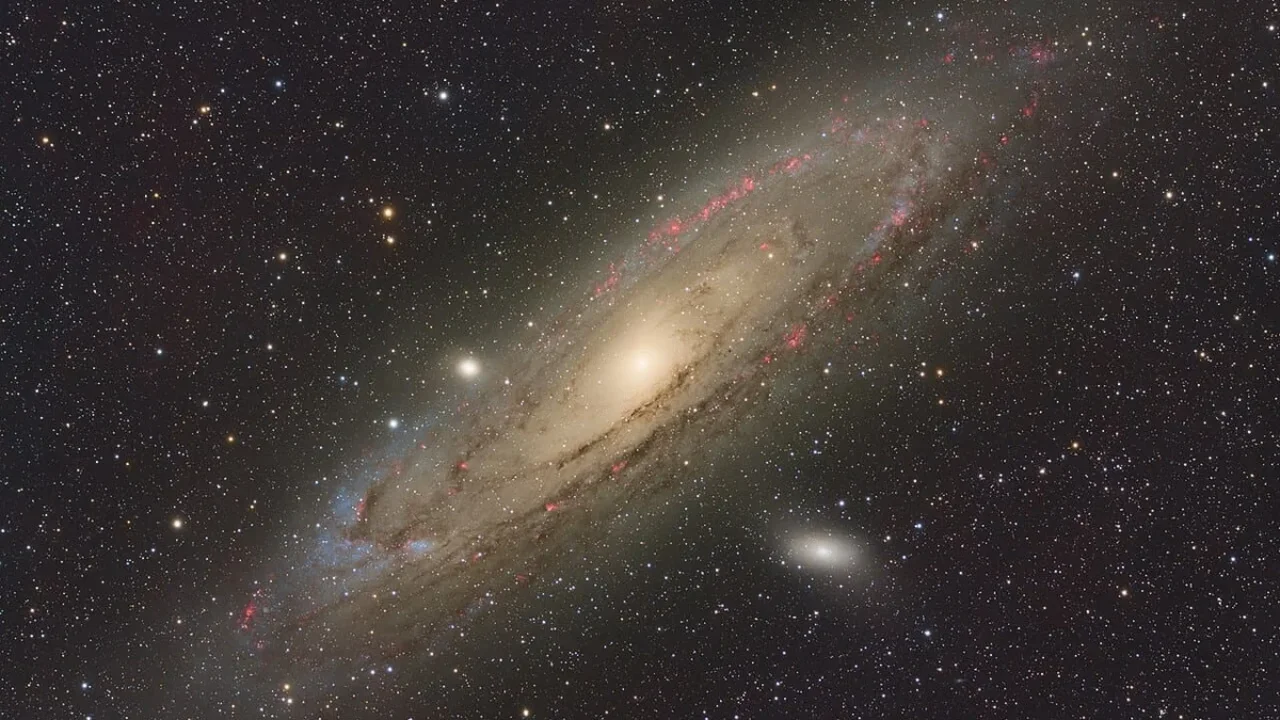
NASA's Hubble Space Telescope has revealed a new chapter in the evolution of Andromeda, the Milky Way's nearest large spiral neighbor. According to a study published in The Astrophysical Journal, the galaxy's star formation has been easing for the past 500 million years and has fallen more sharply in the last 40 million.
By examining two major Hubble surveys of Andromeda, researchers mapped the colors of roughly 200 million stars across the galaxy's disk. Because blue stars are typically young and short-lived, while redder stars are older, the team could reconstruct when and where new stars were being born.
The results point to a galaxy that once surged with activity. Around two billion years ago, Andromeda likely experienced a major burst of star formation, possibly triggered by a merger or close encounter with another galaxy. Since then, the pace has gradually cooled. About 500 million years ago, Andromeda was forming stars at roughly one solar mass per year. By 40 million years ago, that had dropped to about half a solar mass annually, and today it is closer to one-fifth.
Much of the recent activity has been concentrated in a ring about 32,000 light-years from the galaxy's center, but even that region has slowed. The decline appears strongest on the side facing Messier 32, a compact satellite galaxy that may have influenced Andromeda's recent evolution.
Scientists say the findings do not prove a direct cause, but they add weight to the idea that nearby galactic interactions can reshape how stars are formed over time. The study also highlights the value of long-running archival observations, which allow astronomers to treat galaxies like living systems with visible histories.
With future surveys from NASA's Nancy Grace Roman Space Telescope, researchers expect an even broader view of Andromeda's stellar population. The coming data may deepen our understanding of how large galaxies mature, settle, and transform across cosmic time.