For many years, it was assumed that mathematical reasoning emerged only after the advent of numbers and written language. However, a groundbreaking study has unveiled evidence of mathematical thought dating back to 8,000-year-old painted pottery from northern Mesopotamia.
This research focuses on some of the earliest plant representations in human history, indicating that these designs were more than mere decorations. The intricate patterns and forms suggest that early agrarian societies had a grasp of symmetry, repetition, and numerical organization nearly 8,000 years ago.
"The designs on these pottery pieces demonstrate that mathematical reasoning existed long before the invention of writing. People expressed concepts of division, sequences, and balance through their artistic creations," stated Sarah Krulwich, a co-author of the study and a research assistant at the Hebrew University.
Exploring Patterns in Ancient Art
The pottery in question was crafted by the Halafian culture, which thrived in northern Mesopotamia from approximately 6200 to 5500 BCE, marking some of the earliest farming communities in history.
To delve deeper into the artistic expressions of this era, researchers analyzed thousands of pottery shards from 29 archaeological sites. Their aim was to determine when plant imagery began to feature prominently in human art and whether these motifs adhered to specific patterns.
In earlier prehistoric art, human and animal figures predominated. "Given the rarity of plant motifs, we categorized them into four primary types: flowers, shrubs, branches, and trees," the authors of the study explained.
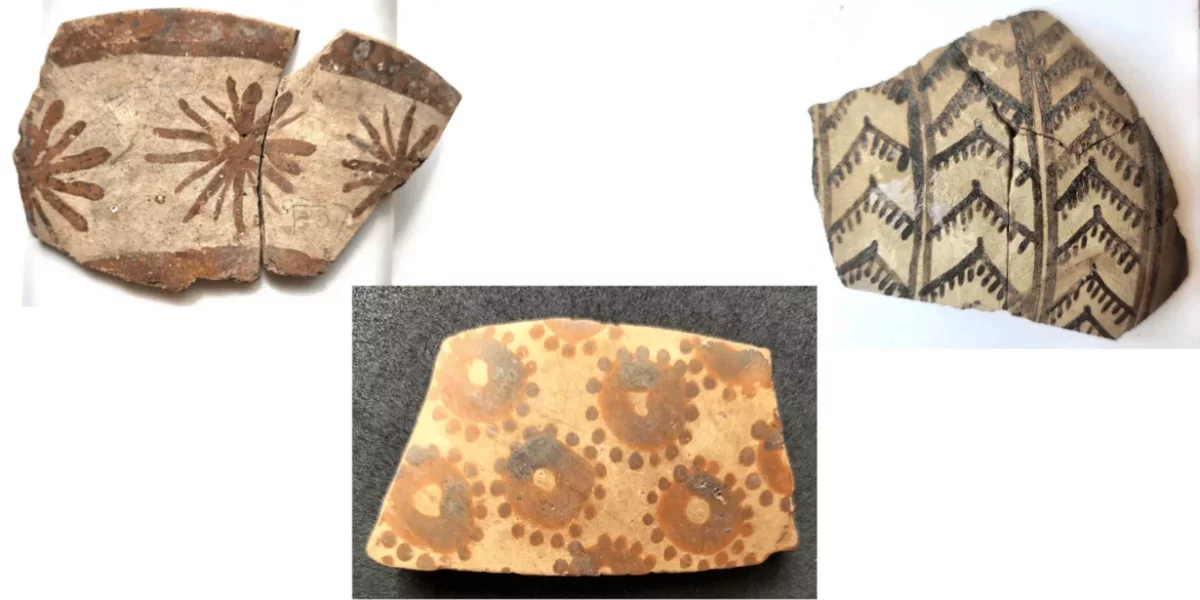
Flowers emerged as the most frequently depicted plant motif, rendered with remarkable precision. Notably, the absence of edible crops in these images suggests that the pottery was not created to document agricultural practices or rituals.
Instead, researchers propose that the choice of flowers stemmed from their aesthetic value and emotional resonance, making them ideal subjects for exploring themes of balance, symmetry, and beauty.
Numerical Patterns Without Written Numbers
Upon examining the number of petals illustrated in these floral designs, researchers discovered a fascinating trend. Many flowers adhered to clear numerical sequences: 4, 8, 16, 32, and occasionally even 64 petals arranged symmetrically.
"The representation of flower petals in geometric sequences such as 4, 8, 16, and 32 suggests an understanding of arithmetic concepts," the authors noted.
Dividing a circular design into equal segments necessitates advanced planning and spatial reasoning.
Interestingly, while some flowers displayed irregular petal counts, researchers attribute these anomalies to variations in artistic skill rather than a different mathematical system.
The consistent emergence of doubling patterns across various sites indicates that Halafian artists shared a unified approach to spatial organization.
Critically, these artistic expressions predate the earliest known written numerical systems in Sumer by thousands of years. Despite the absence of numerals or counting marks, the evidence of mathematical thought was clearly manifested visually.
Understanding Ethnomathematics
Rather than appearing abruptly with the introduction of writing and accounting, mathematical reasoning likely evolved gradually through everyday activities--such as decorating objects, managing resources, and organizing communal spaces.
"The ability to evenly divide space, as reflected in these floral designs, likely originated from practical needs in daily life, such as sharing harvests or managing community land," stated Yosef Garfinkel, a co-author of the study and a professor at Hebrew University.
This research reinforces the emerging perspective in ethnomathematics, suggesting that mathematics is not confined to textbooks and symbols but is also embedded in cultural practices like art and craftsmanship. In this light, mathematics may have begun as a means of interpreting and structuring the world long before it was formalized as a written language.
Future research will aim to identify similar patterns in other prehistoric artistic traditions, such as engravings or architectural designs. If consistent mathematical structures are found across diverse cultures and materials, it would further substantiate the idea that mathematics is an intrinsic aspect of human social development.
The findings are published in the Journal of World Prehistory.