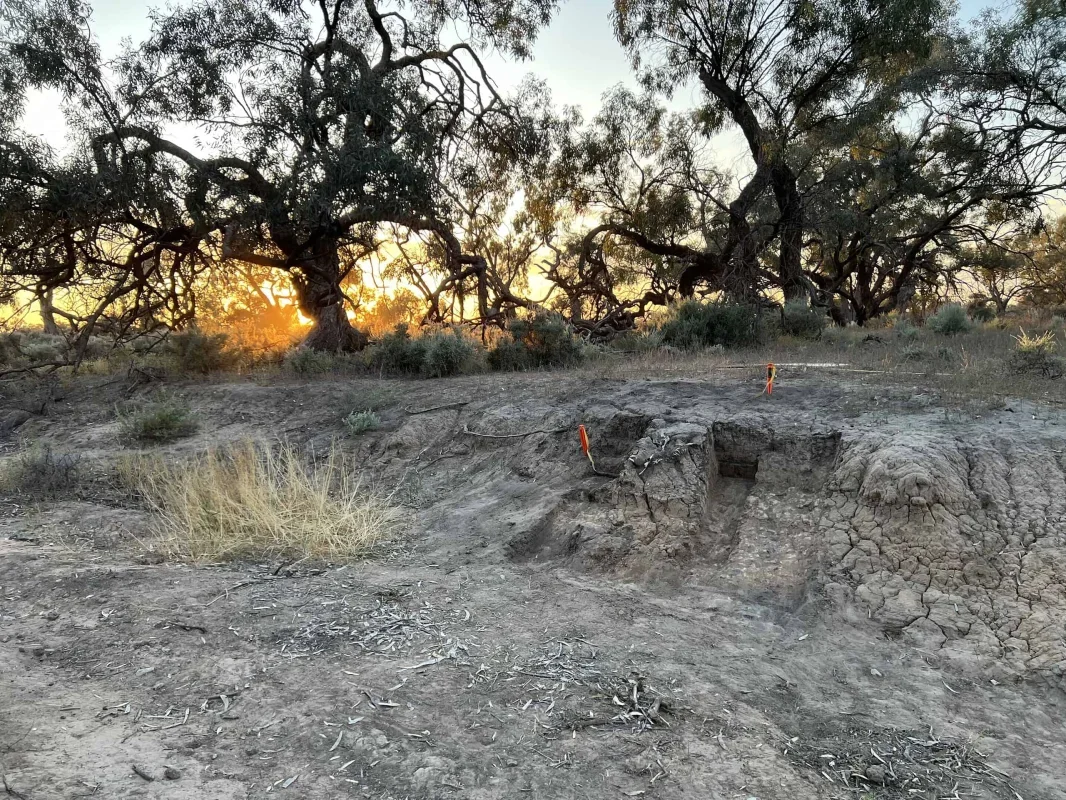
For nearly a millennium, the remains of a dingo, known as garli in the Barkindji language, rested in a riverside midden on Barkindji Country, western New South Wales, Australia. Recent erosion unveiled this ancient skeleton along the Baaka/Darling River, capturing the interest of Barkindji Elder Uncle Badger Bates and archaeologist Dan Witter.
New research indicates that this male dingo was not just a wild animal but a valued member of the local community, cared for during his life and honored in death. The findings, published in Australian Archaeology, reveal that the garli was intentionally buried between 963 and 916 years ago in what is now Kinchega National Park, marking the first documented dingo burial in the area.
The Old Dog by the River
The Barkindji Elders have long emphasized the profound bond between their people and garli. While many perceive dingoes as elusive and wild, this burial illustrates a different narrative. The research, conducted in 2023, commenced after flooding and erosion threatened the skeleton's integrity, and before excavation, a ceremonial smoking ritual was held by Barkindji Elders.
Estimations from a surviving lower canine tooth indicate that the dingo was approximately 4 to 7 years old at the time of death, an advanced age for its species. Unlike typical wild dingoes that often return to the wild after reaching maturity, this individual chose to remain with humans, suggesting a unique bond.
The dingo's dental wear patterns further support this notion, as the back teeth showed significant wear typical of domesticated animals rather than wild ones. This suggests that he lived closely with humans, having access to food scraps and bones from communal life.
Evidence of healed injuries on the dingo's bones indicates that he likely received care from humans throughout his life. Dr. Loukas Koungoulos, the study's lead author, remarked, "The healed injuries, worn teeth, and careful burial demonstrate that this animal lived a long life alongside people, and that his death was marked with respect."
A Respected Dingo
The burial site, rich with freshwater mussel shells and cultural artifacts, underscores the significance of the dingo in Barkindji culture. Radiocarbon dating of the vertebrae confirmed its age, revealing that the dingo was buried with the same care afforded to human ancestors, adorned with shells as a sign of respect.
Remarkably, for centuries following the burial, people continued to bring shells to the grave, a practice described by Barkindji Elders as a ritual of "feeding" the ancestral garli, akin to how they would honor their human ancestors.
This practice may represent the first scientifically documented instance of post-death feeding for a dingo, highlighting the deep cultural respect held for these animals.
Modern Science Meets Ancient Wisdom
This discovery beautifully intertwines modern archaeological methods with ancient Barkindji traditions. While science can analyze the remains and provide insights, it is the cultural knowledge that enriches our understanding of this relationship. The garli was not merely a pet; he was a cherished companion, and his legacy endures through the rituals that honored him.
As we reflect on this bond, it becomes clear that the relationship between humans and animals can transcend time, shaping cultural identities and practices that resonate through generations.