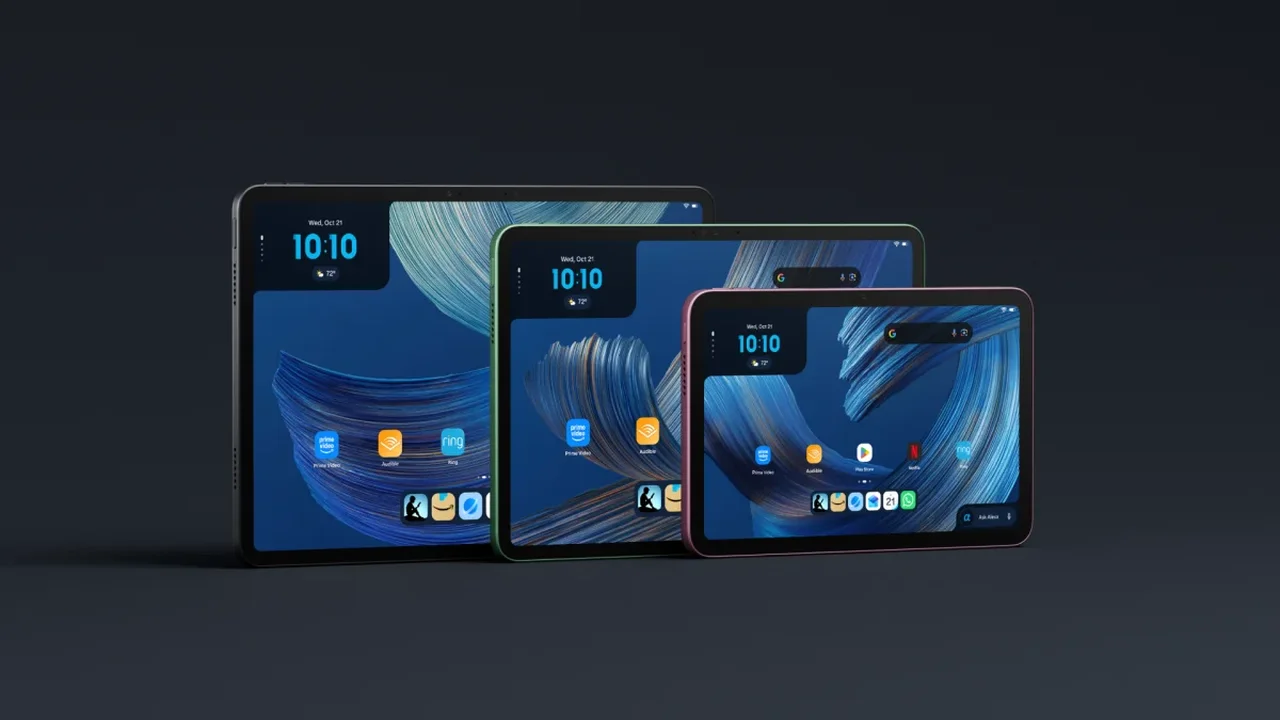
Amazon has announced a new Android tablet family that brings together Alexa+ artificial intelligence, Google Play Store access and refreshed hardware. The range includes the Alexa Tablet 12 Pro, Alexa Tablet 11 and Alexa Tablet 8, designed for productivity, entertainment, reading and connected-home use.
A broader Android experience
Unlike Amazon's previous Fire Tablet lineup, the new devices run Android and offer direct access to the Google Play Store. Users can download widely used apps such as YouTube, Netflix and Gmail alongside Amazon services. Each model features an aluminum unibody design and a high-resolution display.
The flagship Alexa Tablet 12 Pro has a 12-inch, 280 PPI screen with a 120Hz refresh rate and 3:2 aspect ratio. Available with either a standard or anti-glare Nanomatte display, it is positioned for multitasking, 4K streaming, gaming and creative work. Amazon says it delivers major gains in processing and graphics performance over its earlier tablets, with Wi-Fi 6E, Dolby Atmos audio and up to 16 hours of video playback.
A dedicated Pro Pen and Pro Keyboard are also available for the 12 Pro, extending its potential as a portable workstation. Pricing starts at $499.99, while the Nanomatte version starts at $549.99.
Three sizes for different routines
The Alexa Tablet 11 offers an 11-inch 2.5K display, 90Hz refresh rate, dual Dolby Atmos speakers and up to 15 hours of video playback. It starts at $329.99. The more compact Alexa Tablet 8 features an 8.7-inch screen, weighs 329 grams and starts at $229.99, targeting everyday portability for reading, browsing and streaming.
All models include Alexa+ through voice activation or an Ask Alexa button. Its On-Screen Intelligence feature can interpret on-screen content and provide contextual assistance, such as helping users choose an activity from a displayed list. A redesigned Kindle mode also reduces notifications and blue light, with battery life reaching up to 20 hours for reading.
Amazon plans to launch the tablets on October 14 in the United States, Mexico and Canada, followed by selected European markets on October 19. By combining open app access with contextual AI, the range signals a future in which tablets become more adaptive companions for work, learning and leisure.