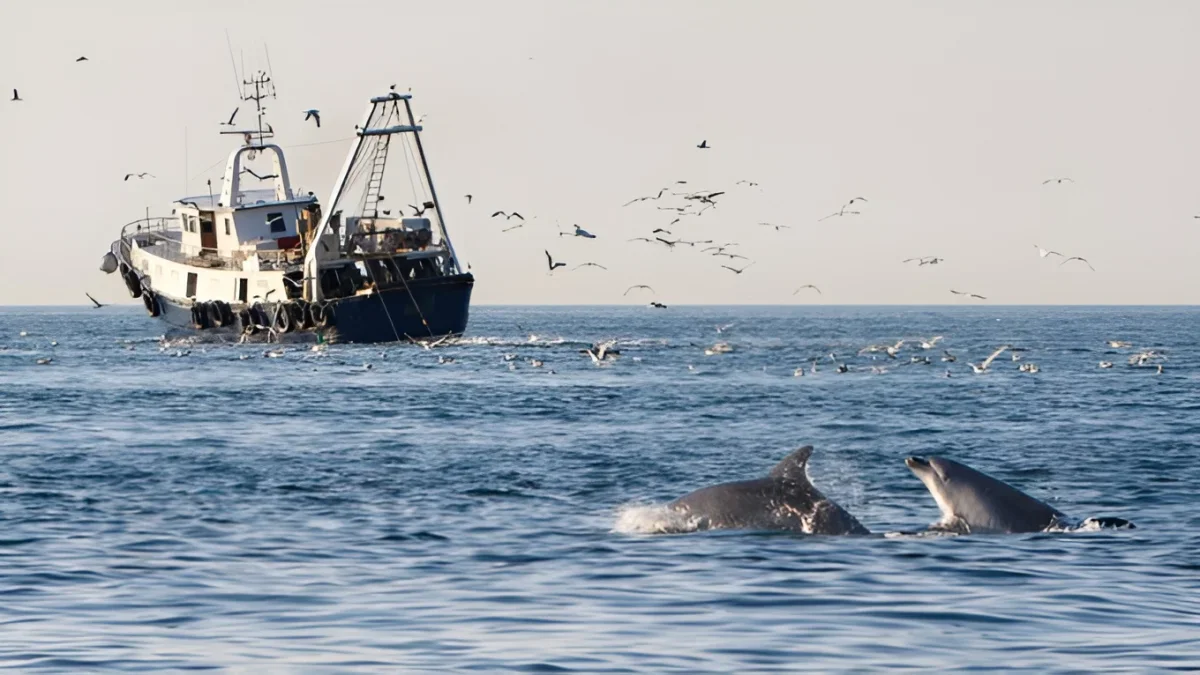
In the northern Adriatic Sea, bottlenose dolphins are showing an unusual feeding pattern: many now follow commercial trawlers to find food. A new study suggests this behavior is not just opportunistic, but a response to a marine ecosystem under heavy pressure.
A changing food web in the Adriatic
Researchers say decades of intensive trawl fishing have reshaped the region's underwater environment. As fish stocks have declined, dolphins appear to be spending more time around fishing vessels to catch escaping fish, feed on disturbed prey, and collect scraps left behind.
The study focused on waters off Veneto and Marche in Italy. Between 2018 and 2025, scientists spent 148 days at sea, covered more than 17,700 kilometers, and inspected 859 trawlers. Their observations showed dolphins following 76% of trawlers in Marche and 26% in Veneto.
Photo-identification data also revealed that 86% to 90% of the local bottlenose dolphin population, more than 1,000 animals, now uses trawlers as feeding sites. That is a major shift from the early 1990s, when only about 10% of inspected trawlers were followed.
Learning a new feeding strategy
The behavior seems to be spreading through social learning. Young dolphins often accompany their mothers near trawlers, observing how adults feed around nets and gradually adopting the same approach. Scientists describe this as a form of cultural transmission within the population.
While trawlers offer an easier meal, they also change dolphin movement, diet, and daily routines. The study notes that this growing dependence reflects adaptation to a sea where natural prey is becoming harder to find.
Published in Frontiers in Mammal Science, the research highlights both the resilience of bottlenose dolphins and the importance of healthier fishing practices. If marine ecosystems recover, dolphins may once again rely more on natural prey, offering a clearer path for biodiversity in the Adriatic's future.