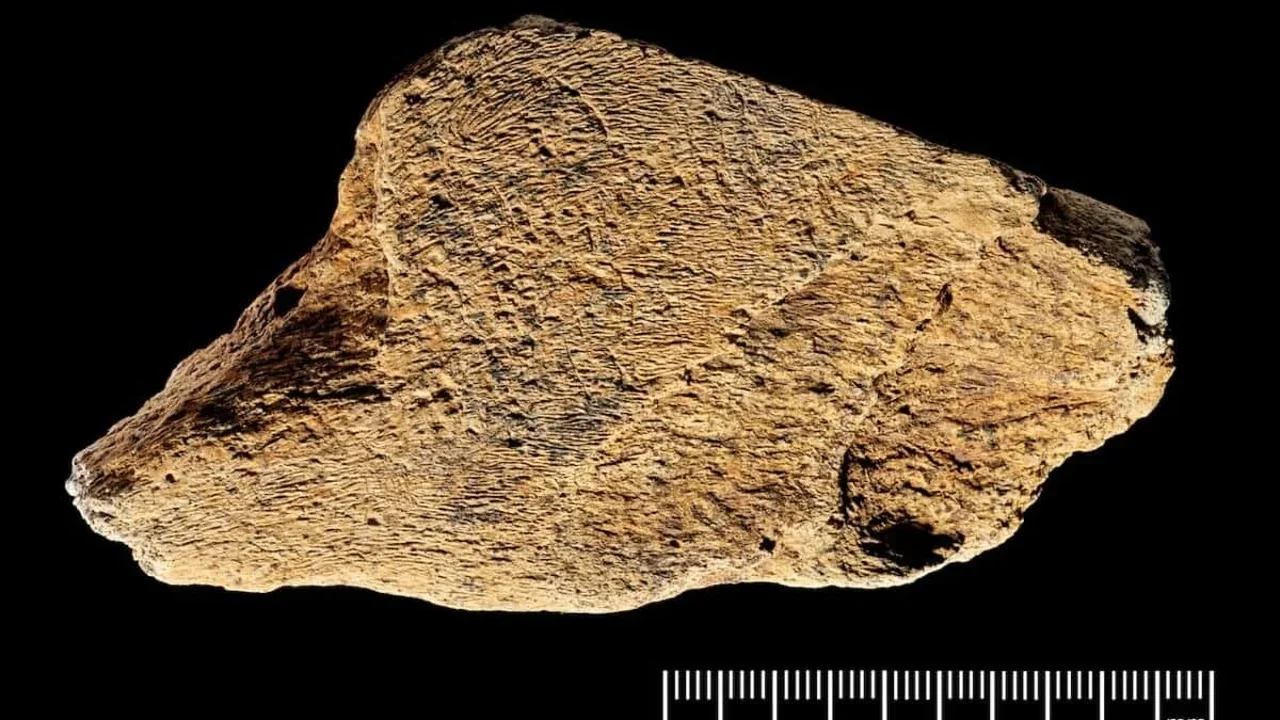
Archaeologists working at Boxgrove in West Sussex have identified an extraordinary prehistoric implement: a triangular fragment of elephant bone shaped and used as a soft hammer to sharpen flint handaxes nearly 480,000 years ago.
The palm-sized object, long stored in collections without its full purpose being recognized, is now understood as a carefully made retoucher. Its surface carries repeated impact marks, tiny flint fragments, and wear patterns that show it was used to remove small flakes from stone edges with controlled, precise strikes.
A Rare Material, Used with Purpose
The bone likely came from a straight-tusked elephant or a steppe mammoth. Researchers say the maker selected a durable section of bone, trimmed it into a practical shape, and carried it as a reusable tool. That choice points to a sophisticated understanding of how different materials perform in stone tool production.
Microscopic and 3-D analysis revealed several battered zones and embedded flint chips, suggesting the tool was used in multiple sharpening sessions. The wear indicates it was not meant for heavy shaping, but for fine maintenance of already finished handaxes.
Boxgrove's Prehistoric Workshop
Boxgrove is one of the most important early human sites in Britain. It has yielded finely made handaxes, butchered animal remains, and some of the oldest human fossils found in the region, linked to Homo heidelbergensis. The new discovery adds another layer to that picture, showing that early humans in the area worked with a broader and more adaptable toolkit than previously understood.
The study also highlights how rare preservation can preserve details of daily life from deep prehistory. At Boxgrove, fine sediments helped protect tools and bones in place, allowing scientists to reconstruct ancient behavior with unusual clarity.
Published in Science Advances, the research suggests that early humans were not only making tools, but also refining and reusing them with planning and precision. This kind of discovery helps redraw the timeline of technological intelligence, offering a glimpse into how innovation may have evolved long before written history.