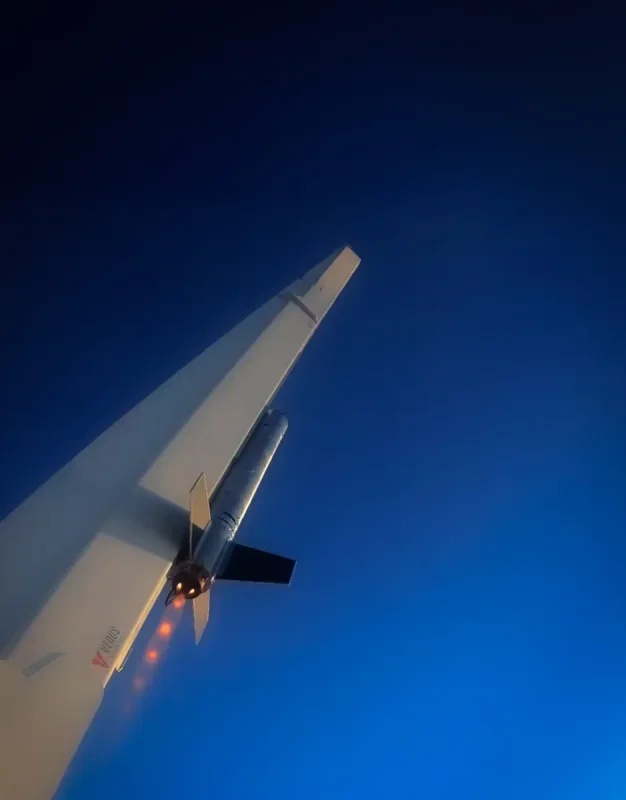
Venus Aerospace has raised $90 million in Series B funding to accelerate work on its rotating detonation rocket engine, a propulsion system designed to improve efficiency and performance for future flight applications.
Founded in 2020 by CEO Sassie Duggleby and CTO Andrew Duggleby, the company initially set out to develop hypersonic passenger aircraft. After a successful flight demonstration of its engine, Venus shifted focus toward high-speed space systems and defense-oriented propulsion.
The latest round was led by Mercury Fund, with participation from Lockheed Martin Ventures, MESH, PEAK6, Draper Associates, Starboard Star Venture Capital, and Green Sands Equity. The capital will support testing, development, and vehicle design work with prospective customers.
The rotating detonation rocket engine is based on a long-studied concept that uses a continuous supersonic combustion wave inside a circular channel. Recent advances in 3D printing and simulation tools have helped make the technology more practical, while Venus says it has solved major thermal challenges in its design.
The company has already completed hundreds of tests, and its longest engine run has reached 32 seconds. With a new test stand supported by the Texas Space Commission, Venus is preparing for longer-duration burns that could bring the system closer to operational use.
This milestone highlights how propulsion innovation may shape faster, more efficient, and more adaptable aerospace systems in the years ahead.