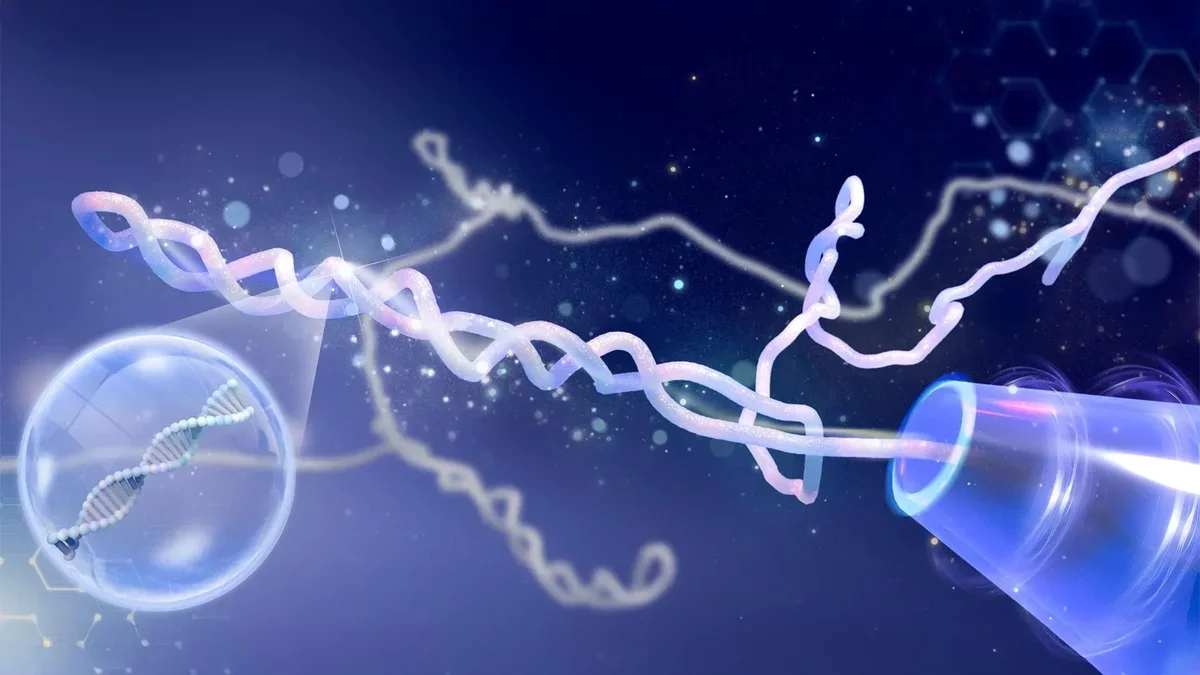
Nanopores are tiny openings that facilitate the passage of single DNA strands while generating electrical signals, which are crucial for in-depth genetic analysis. Recent findings have revealed that significant aspects of these signals were previously misinterpreted.
Misconceptions About DNA Knots
For years, scientists believed that the intricate electrical patterns observed during nanopore experiments were due to DNA forming knots. This notion was easily visualized; akin to pulling a shoelace through a small hole, any tangling would create unevenness. Consequently, any irregular electrical signal was assumed to indicate that the DNA strand had knotted while traversing the nanopore.
This perspective influenced the interpretation of nanopore data for decades.
Twists Revealed as the True Culprit
A groundbreaking study published in Physical Review X has challenged this long-held belief. The research indicates that rather than forming actual knots, DNA often twists around itself during its journey through the nanopore. These twisted configurations, termed plectonemes, resemble a coiled phone cord rather than a knot.
This distinction is vital, as twists and knots influence electrical signals in fundamentally different manners.
Lead researcher Dr. Fei Zheng from the Cavendish Laboratory stated, "Our experiments demonstrated that as DNA is drawn through the nanopore, the ionic flow induces twisting, accumulating torque and forming plectonemes instead of just knots. This 'hidden' twisting structure leaves a unique and persistent mark in the electrical signal, contrasting with the fleeting signature of knots."
Identifying a Missing Mechanism
The research team examined DNA utilizing both glass and silicon nitride nanopores under various voltages and conditions. They discovered that so-called "tangled" instances, where multiple sections of DNA occupied the pore simultaneously, occurred much more frequently than knot theory could account for.
These occurrences increased with higher voltages and longer DNA strands, suggesting that another force was at play.
Understanding the Impact of Electroosmotic Flow
The researchers identified that the twisting originates from electroosmotic flow, which is the movement of water propelled by electric fields within the nanopore. As water flows past the DNA, it exerts a rotational force on the helical molecule. This torque propagates along the strand, leading to sections outside the pore coiling into plectonemes.
Unlike knots, which tighten under tension and typically vanish quickly, plectonemes can expand and persist throughout the translocation process. Computer simulations validated this behavior, demonstrating that plectoneme formation relies on DNA's capacity to transmit twist along its length.
Verifying the Findings Through Experimentation
To further investigate, the team created "nicked" DNA strands, which had interruptions at specific points. These interruptions inhibited twist propagation along the molecule, significantly decreasing plectoneme formation during tests.
This outcome confirmed the essential role of twist propagation in the process and suggested new methodologies for utilizing nanopores to detect DNA damage, as breaks in the strand disrupt twisting behavior.
Enhancing DNA Signal Interpretation
Prof. Ulrich F. Keyser, a co-author of the study, remarked, "The significant insight here is our newfound ability to differentiate between knots and plectonemes in nanopore signals based on their duration. Knots pass through quickly, akin to a brief bump, while plectonemes linger, producing extended signals. This advancement paves the way for richer insights into DNA organization, genomic integrity, and potential damage."
Wider Implications for Science and Technology
The implications of these findings extend beyond nanopore sensing. In living cells, DNA frequently twists and tangles as enzymes interact with it, with both knots and plectonemes playing crucial roles in genome organization and stability. Gaining a deeper understanding of how these structures form could enhance models of cellular DNA behavior.
Moreover, the ability to detect or manipulate DNA twisting could lead to more sensitive diagnostic tools capable of identifying subtle genetic alterations and early indicators of DNA damage associated with various diseases. Dr. Keyser concluded, "From a nanotechnology perspective, this research underscores the potential of nanopores, not only as advanced sensors but also as instruments for innovatively manipulating biopolymers."