Researchers in China have taken a notable step toward drones that can stay airborne longer by recharging with laser light. The team created a lightweight receiver that converts concentrated laser energy into electricity, reaching 38.49% efficiency in lab tests.
The system was designed by scientists working at the Civil Aviation University of China, with senior author Jianhua Han describing a future in which drones could support forest monitoring, emergency response, and delivery missions without frequent landings.
How the device works
Instead of collecting sunlight like a conventional solar panel, the receiver is tuned to capture laser beams. Its core uses perovskite, a material known for strong light-to-electricity conversion. The design combines two layers: one turns laser light directly into power, while the other harvests electricity from the temperature difference created when the front side heats up more than the back.
That heat difference is useful, but it also creates a challenge. During testing, the device reached temperatures of 80 to 90°C, which pushed the team to improve thermal control. To solve this, they added antimony triselenide nanocrystals, which help slow heat transfer and protect the device's performance.
Built with cooling in mind
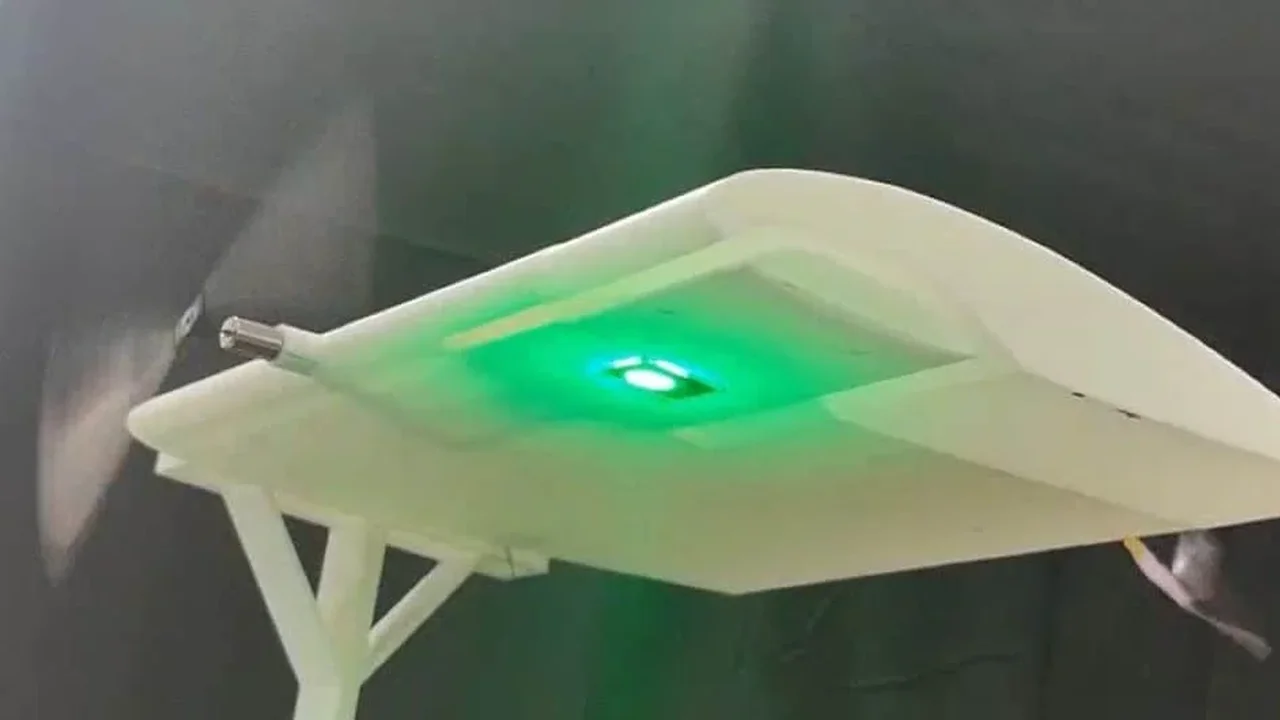
The researchers also integrated the receiver into a drone wing model and added air channels to improve cooling. In a stationary experiment, a green laser supplied enough energy to spin the propeller, showing that the setup can support motion while managing heat more effectively.
The next step is outdoor flight testing on a lightweight drone. Real-world use will require the laser to track a moving aircraft with precision, while also handling weather and atmospheric interference. Even so, the concept points toward a new model of aerial energy transfer, where drones may one day receive power while in motion. This could reshape how future autonomous aircraft operate across science, logistics, and environmental monitoring.