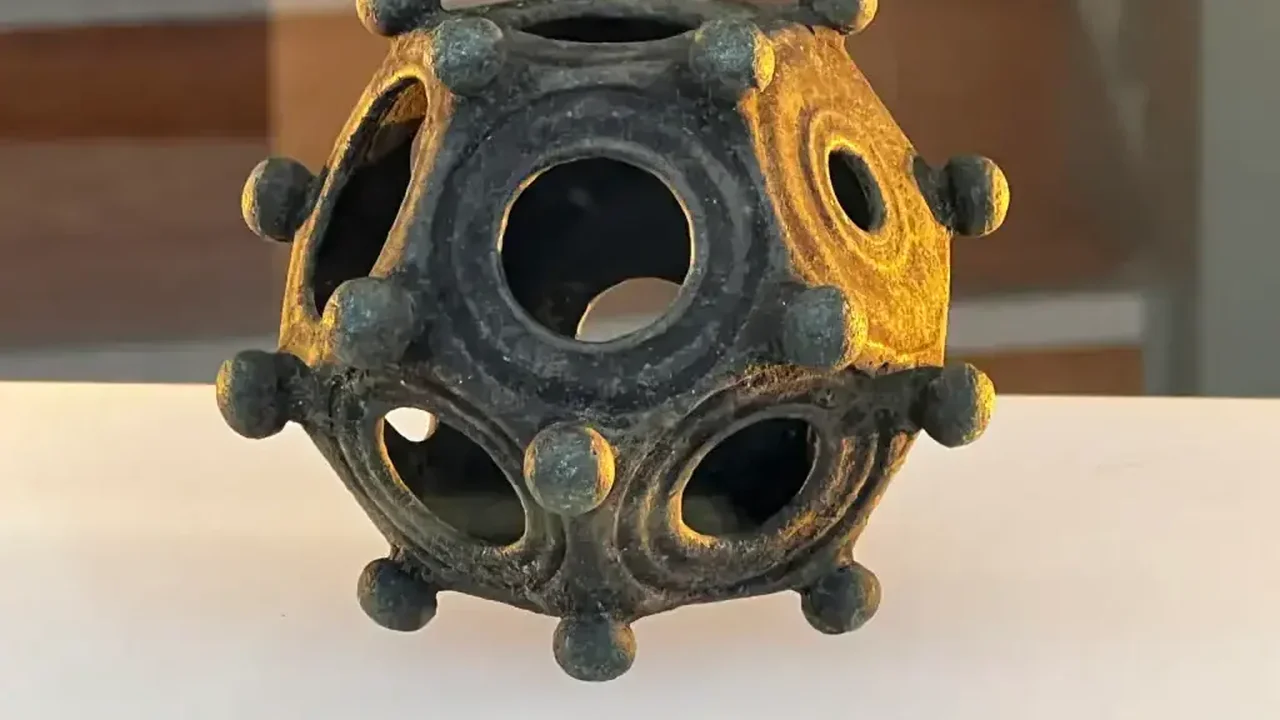
In June 2023, the Norton Disney History and Archaeology Group uncovered an unusually well-preserved Roman dodecahedron near Norton Disney in Lincolnshire, England. The copper-alloy object is about the size of a grapefruit, with 12 pentagonal sides, circular openings and small knobs at each corner.
More than 130 dodecahedrons have been found across Europe, including 33 in Britain. Yet no surviving Roman text or illustration clearly explains what they were made for, and the objects are concentrated in the empire's northwestern regions.
Many theories, no settled answer
Suggested uses range from ritual objects to practical tools for weaving, measuring or marking planting seasons. The Norton Disney group considers a religious role plausible, while a 2025 study in The Antiquaries Journal explored links between the shape and ancient ideas about the cosmos, as well as possible connections to Druidic traditions.
A different possibility appeared in a 2026 study in The EXARC Journal. Researcher Greg Lamb tested whether replicas could shape wax into seals or tokens. In his experiments, the knobs, openings and hollow centre helped form and release the wax. Such pieces may have served to identify goods or organise supplies, although the idea remains unconfirmed.
The artifact's exact function is still unknown. Its careful construction and distinctive regional spread continue to offer archaeologists valuable clues about Roman-era craftsmanship and beliefs. Further study may reveal how these objects connected everyday life with the ideas and practices of their time.