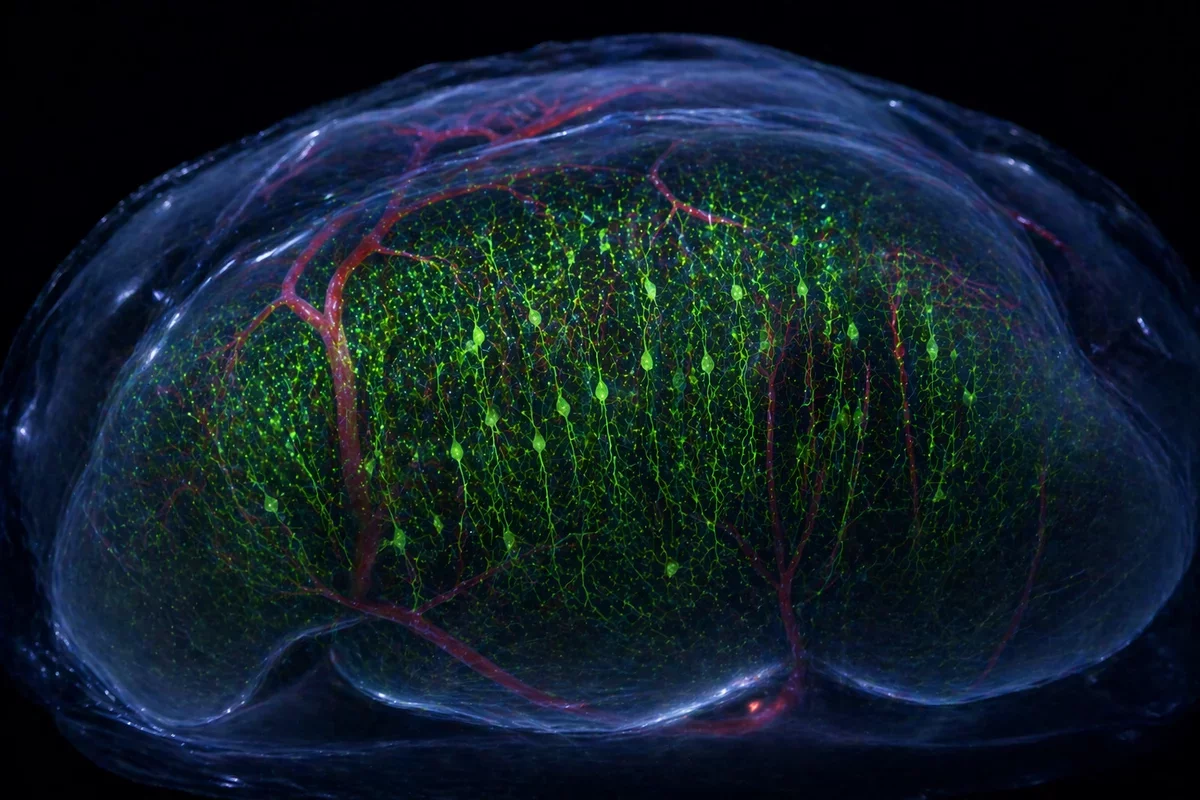
In a groundbreaking advancement, researchers from Kyushu University have developed a method that allows for the temporary transparency of living brain tissue, enabling unprecedented observation of neuronal activity. This innovative approach utilizes a specific chemical agent that creates a clear window into the brain, revealing individual neurons firing within the cerebral cortex.
The technique leverages a naturally occurring protein found in blood, facilitating deeper imaging in both acute brain slices and living mice without compromising the health and functionality of the brain. This breakthrough provides a unique opportunity to study the brain in its active state, offering insights into its complex processes.
Understanding the Optical Phenomenon
To illustrate this concept, consider glass marbles submerged in water versus heavy oil. In water, the marbles are visible due to light refraction; in oil, they become nearly invisible due to matching refractive indices. The challenge with brain tissue lies in its complex composition, which distorts light in various ways. By adjusting the surrounding fluid's refractive index to align with that of the brain cells, transparency can be achieved.
Professor Takeshi Imai has dedicated years to this optical challenge, previously creating transparency in preserved tissues. The leap to living brains posed significant hurdles, but the team has now succeeded.
"When we first made postmortem specimen mouse brains transparent, people asked when we would achieve this with living subjects," Imai stated. "We have finally done it, and I hope this will enhance various research studies."
A Journey of Discovery
To find the right optical balance, the researchers needed a chemical that would not harm living cells. They discovered that using large, spherical molecules could reduce osmotic pressure, thus preserving cell integrity. Assistant professor Shigenori Inagaki tested nearly 100 different polymers before serendipitously finding that Bovine Serum Albumin (BSA) was the ideal candidate.
The newly developed solution, named SeeDB-Live, allows brain slices to become transparent within 30 to 60 minutes, enhancing the visibility of neuronal activity significantly. This method does not permanently alter the brain; the fluid is naturally expelled, restoring the brain's original state, allowing for repeated imaging over extended periods.
Implications for Neuroscience
The implications of this technique are profound. It opens new avenues for understanding healthy brain function and the effects of diseases such as Alzheimer's. Additionally, it provides pharmaceutical researchers with the ability to observe changes in artificially grown brain organoids, paving the way for innovative drug development.
"SeeDB-Live can revolutionize deep-tissue live imaging in both ex vivo and in vivo settings," Inagaki remarked. Although challenges remain, such as the need for surgical access to the brain, the potential for less invasive methods is on the horizon.
With this pioneering technique, researchers can now explore the intricate workings of the brain like never before, potentially leading to significant advancements in neuroscience and therapeutic interventions.