A groundbreaking collaboration between the NOvA experiment in the United States and Japan's T2K project has yielded fresh insights into the enigmatic role of neutrinos following the Big Bang. By merging data from these two sophisticated neutrino experiments, researchers aim to unravel the mystery of why our universe is predominantly composed of matter rather than antimatter.
Both NOvA and T2K utilize powerful particle accelerators to generate neutrino beams that travel vast underground distances to massive detectors. Detecting these elusive particles is a formidable challenge, as only a minuscule fraction of the generated neutrinos produce measurable signals. Advanced detection technologies and sophisticated software are employed to reconstruct these rare interactions, enabling scientists to analyze how neutrinos evolve during their journey.
Indiana University has been pivotal in this research for many years, with its scientists actively contributing to detector construction, data interpretation, and mentoring emerging researchers. Mark Messier, a Distinguished Professor and Chair of the Physics Department at IU Bloomington, has been a key figure in the project since 2006, alongside other notable physicists from the university.
Understanding Neutrinos and the Matter-Antimatter Conundrum
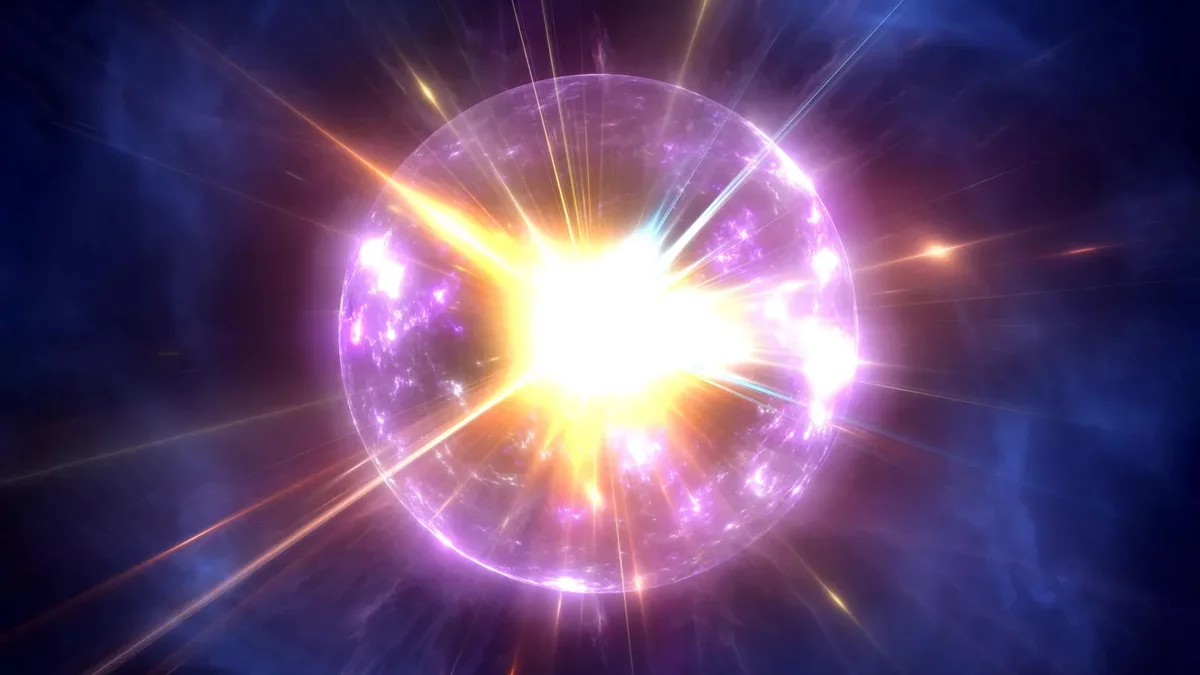
Neutrinos are among the universe's most abundant particles, lacking electric charge and possessing minimal mass, which complicates their detection. However, their unique properties make them essential for probing fundamental physics questions. One of the most significant challenges in cosmology is understanding why the universe is primarily made of matter. The Big Bang should have produced equal amounts of matter and antimatter; if so, their interactions would have led to mutual annihilation, leaving nothing behind. Yet, the observable universe is rich with matter, allowing for the formation of galaxies, stars, and life itself.
Researchers propose that neutrinos could shed light on this imbalance. They exist in three "flavors"--electron, muon, and tau--and can oscillate between these states as they travel. If neutrinos and their antimatter counterparts oscillate differently, this could explain the matter's supremacy.
Collaborative Insights from NOvA and T2K
This recent study stands out for its integration of data from two leading neutrino observatories. NOvA directs a neutrino beam 810 kilometers from the Fermi National Accelerator Laboratory to a 14,000-ton detector in Minnesota, while T2K sends a beam 295 kilometers from Japan's J-PARC accelerator to the Super-Kamiokande detector. This collaboration enhances the precision of neutrino behavior measurements by leveraging the distinct strengths of both experiments.
The combined analysis has refined the understanding of neutrino oscillations, particularly concerning differences between neutrinos and antineutrinos. The findings suggest a potential violation of CP symmetry, indicating that neutrinos may not behave identically to their antimatter counterparts, which could be crucial in explaining why matter prevailed in the universe.
Professor Messier emphasized the significance of this research in addressing profound questions about existence, stating that it paves the way for future inquiries into neutrinos and their implications.
Technological Advancements and Global Collaboration
The collaborative effort not only advances fundamental science but also fosters technological innovations applicable across various industries. With support from the U.S. Department of Energy, these experiments exemplify the benefits of international scientific cooperation, involving hundreds of researchers from multiple countries.
As the study progresses, Indiana University's involvement continues to inspire the next generation of scientists, equipping them with invaluable skills in data science and advanced technologies. This partnership heralds a new era of exploration into the universe's most profound mysteries.