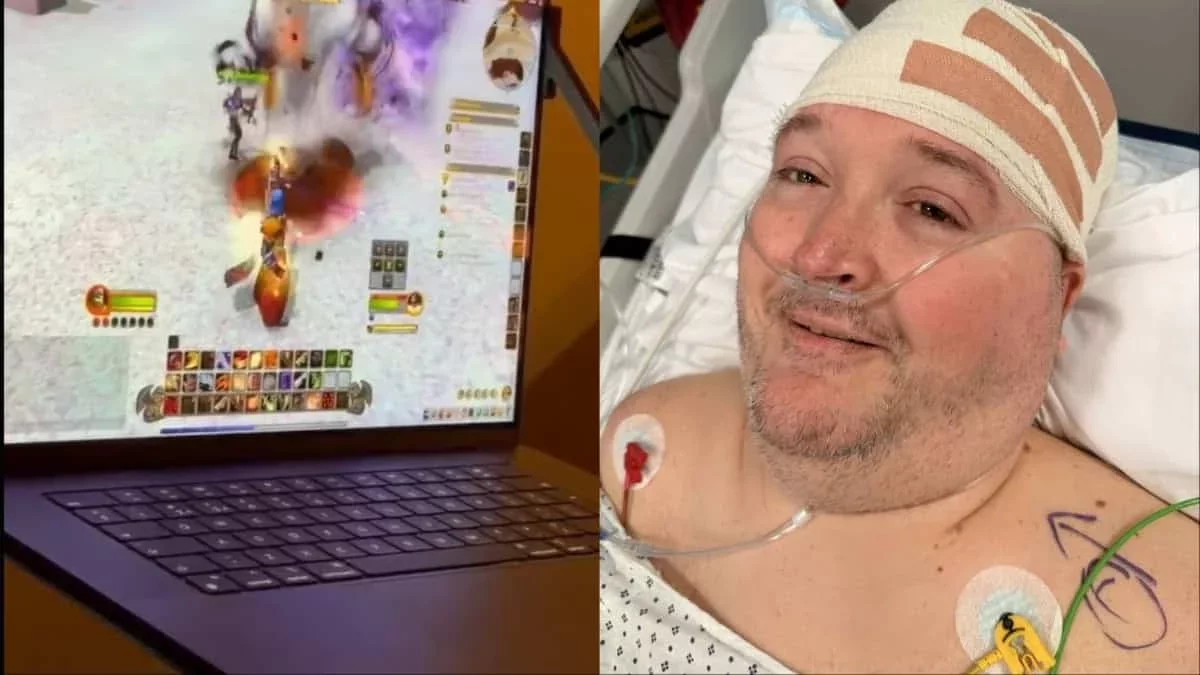
Jon L. Noble's journey with a brain implant has been nothing short of extraordinary. After undergoing brain surgery in London, he quickly transitioned from recovery to manipulating a cursor on a MacBook using only his thoughts. Remarkably, by the 80th day post-surgery, he was immersed in the virtual world of World of Warcraft, navigating his character without any physical input.
A British Army veteran paralyzed from the shoulders down, Noble is among the prominent participants in Neuralink's trial aimed at developing brain-computer interfaces (BCI) for individuals with severe disabilities. His experience highlights the practical applications of this innovative technology, enabling tasks such as typing, scrolling, and even gaming, all through mental commands.
From Surgery to Digital Control
Noble's adventure began with a seemingly straightforward surgical procedure. "The surgery on Day 0 was surprisingly easy," he shared on X. Surgeons utilized a robotic system to insert 1,024 ultra-thin threads into his motor cortex, the brain region responsible for movement planning. Just a day later, he was home, feeling sharper and more positive than he had in years.
However, mastering the technology required a steep learning curve. In the second week, Neuralink engineers connected his implant to an Apple MacBook. Initially, Noble struggled to transform his thoughts into actions on a screen--a task most take for granted. "At first, it felt like trying to remember a dream, but by week three it was second nature," he noted.
Before long, he was proficiently moving the cursor with his mind. "Scrolling, clicking, typing--all mind-controlled," he humorously remarked, noting his rapid transformation from a novice to a power user.
Gaming as a Testbed for Innovation
Video games have emerged as an informal testing ground for brain-computer interfaces, demanding precision and adaptability. Noble's experience with World of Warcraft--a game known for its complexity--was particularly challenging. "The first raid felt clunky, but once my brain and the BCI synced, it was pure magic," he recounted. With practice, he mastered the game, exploring Azeroth hands-free, driven solely by intention.
The N1 implant developed by Neuralink is designed to translate neural activity into digital commands, allowing users to control devices through thought alone. This breakthrough offers profound independence for individuals with spinal cord injuries, enabling them to engage with technology in unprecedented ways.
"It's honestly brilliant. The freedom is addictive," Noble expressed. "The whole journey feels like science fiction that somehow became my everyday reality."
As Noble reflects on his experience, he emphasizes the transformative potential of BCIs. "100 days in and I already can't imagine life without it. The N1 didn't just give me a new way to use a computer--it gave me a new way to live." This pioneering development not only showcases the capabilities of neurotechnology but also opens doors to a future where individuals with disabilities can reclaim their independence and connect with the world around them.