Researchers have made an intriguing discovery regarding the Chinese money plant, or Pilea peperomioides, revealing a hidden mathematical structure within its leaves. This perennial plant, native to the Yunnan and Sichuan provinces of China, is not only a popular houseplant but also a fascinating subject for scientific exploration.
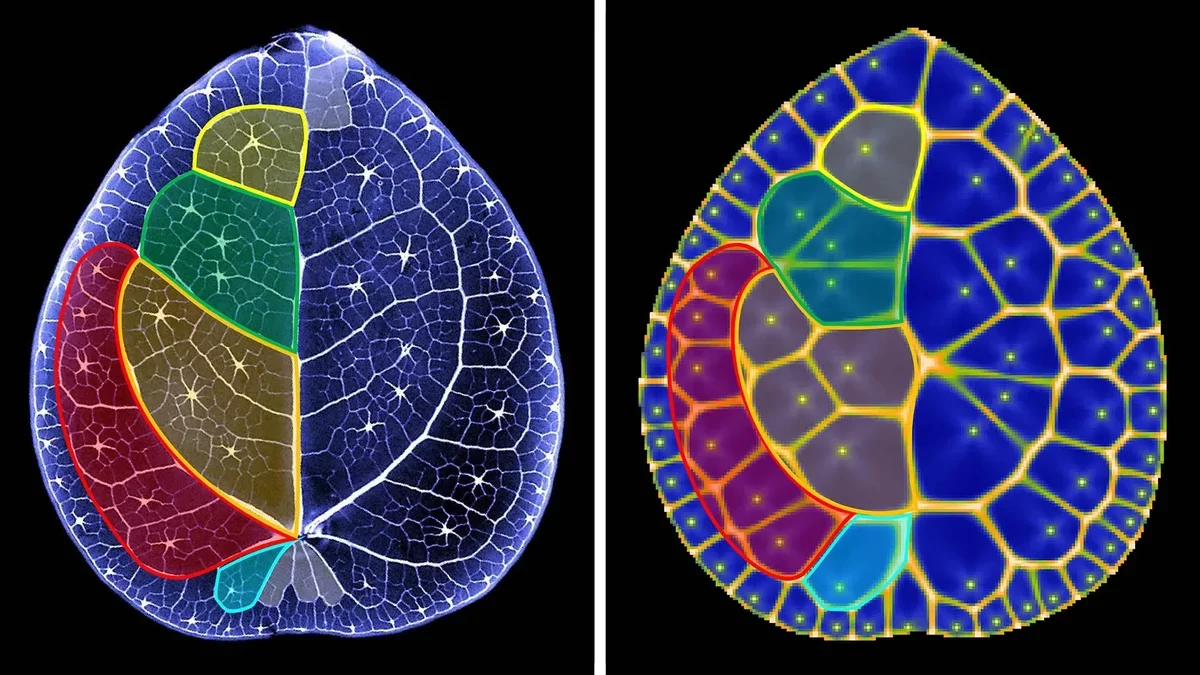
The study centers around the Voronoi diagram, a geometric concept that divides space into distinct regions around central points. These diagrams have been utilized for centuries in various fields, including city planning and network design. However, natural occurrences of Voronoi patterns, such as those seen in the markings of giraffes, typically lack the clear central points found in theoretical examples.
In a breakthrough, scientists including Navlakha and former graduate student Cici Zheng mapped the unique structure of the money plant's leaves, identifying how its pores, known as hydathodes, and the accompanying vein networks form a Voronoi pattern. This discovery is particularly notable as it highlights a rare instance where nature mirrors mathematical principles.
To delve deeper into the mechanics of this pattern formation, the researchers collaborated with renowned scientist Przemysław Prusinkiewicz, who is well-known for his expertise in plant vein patterns. Together, they uncovered a "natural algorithm" that governs the creation of these looping veins around the leaf pores. Zheng, now a postdoctoral researcher at the Allen Institute, remarked, "Plants, unlike humans, cannot measure distances explicitly; they rely on local biological interactions to achieve solutions similar to Voronoi patterns."
This finding emphasizes the capacity of living organisms to develop complex systems without any conscious planning. Navlakha stated, "These algorithms in nature help us understand how organisms behave and provide insight into the world around us." The research serves as a remarkable intersection of classical geometry, modern plant biology, and computer science.
Prusinkiewicz expressed excitement over the implications of these findings, noting that they may resolve longstanding questions regarding the formation of leaf veins. "It's astonishing how mathematical the patterns of plant forms can be," he said. "For years, the mechanisms behind reticulate vein formation have puzzled scientists, and we now have a credible explanation through the Voronoi patterns observed in Chinese money plants."
Looking ahead, Navlakha and Zheng are optimistic that further exploration of these patterns will yield deeper insights into how plants tackle complex biological challenges. They believe this research could ultimately enhance our understanding of the mathematical principles that influence evolution, development, and the essence of life itself.