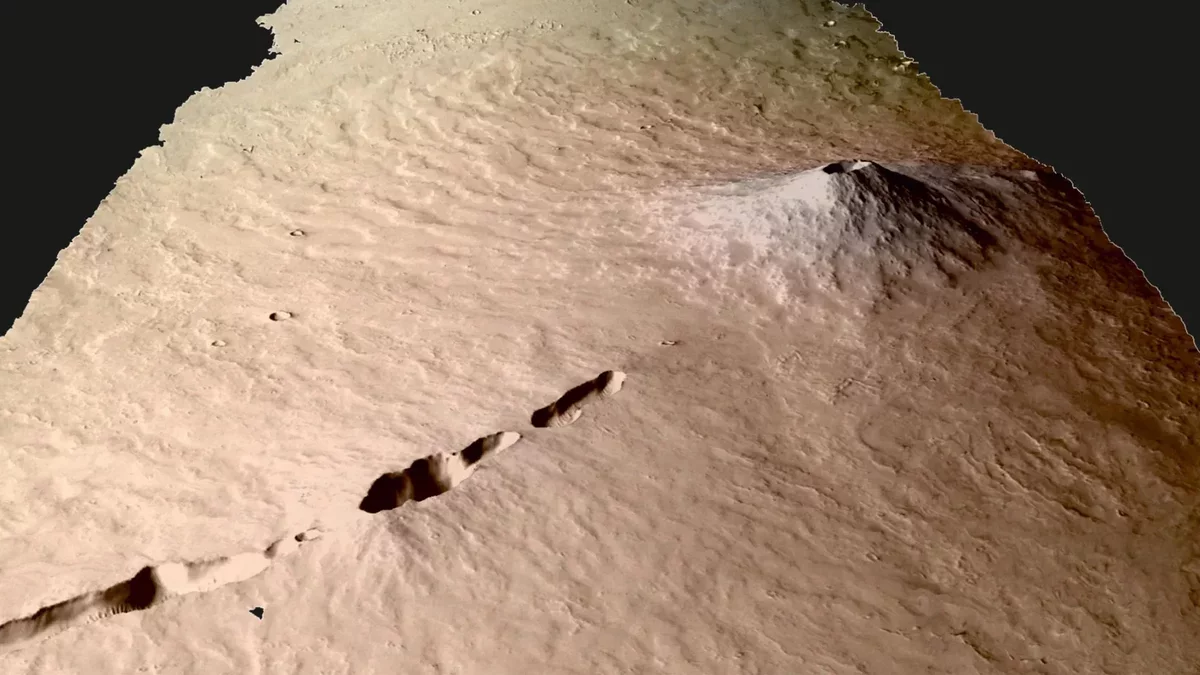
A groundbreaking study featured in Geology reveals that Mars harbors a complex volcanic history. High-resolution imagery and mineral data obtained from orbiting satellites indicate that the planet's youngest volcanic regions possess a far richer narrative than previously thought. Rather than forming from isolated eruptions, these volcanoes emerged from active magma systems that evolved over extended periods beneath the Martian crust.
Investigating the Volcanic System Near Pavonis Mons
A collaborative research team from Adam Mickiewicz University in Poznań, the University of Iowa's School of Earth, Environment and Sustainability (SEES), and the Lancaster Environment Centre focused on a persistent volcanic system located south of Pavonis Mons, one of Mars' largest volcanoes. By meticulously mapping the surface and analyzing mineral data from orbiting spacecraft, the scientists successfully reconstructed the volcano's development and its underlying magma system with impressive accuracy.
"Our findings indicate that even during the latest volcanic activity on Mars, the magma systems beneath the surface were both active and intricate," states Bartosz Pieterek from Adam Mickiewicz University. "The volcano did not experience a single eruption; instead, it evolved as subsurface conditions changed over time."
Identifying Multiple Eruptive Phases Through Mineral Analysis
The research unveiled that the volcanic system underwent several distinct stages. Initial activity saw lava spreading from fissures, while subsequent eruptions emerged from concentrated vents, forming cone-shaped structures. Although these lava deposits appear different today, they all originated from the same magma reservoir. Each phase left a unique mineral signature, enabling researchers to trace the evolution of the magma's composition over time.
"These mineral variations indicate that the magma itself was undergoing changes," Pieterek elaborates. "This likely reflects shifts in the depth of the magma source and the duration it was stored beneath the surface before erupting."
Orbital Observations Provide Insight into Mars' Interior
As direct sampling of Martian volcanoes remains a challenge, studies like this are crucial for understanding the planet's internal structure. The results highlight the significant role of orbital observations in revealing the hidden dynamics and long-term evolution of volcanic systems, not just on Mars but across other rocky planets as well.