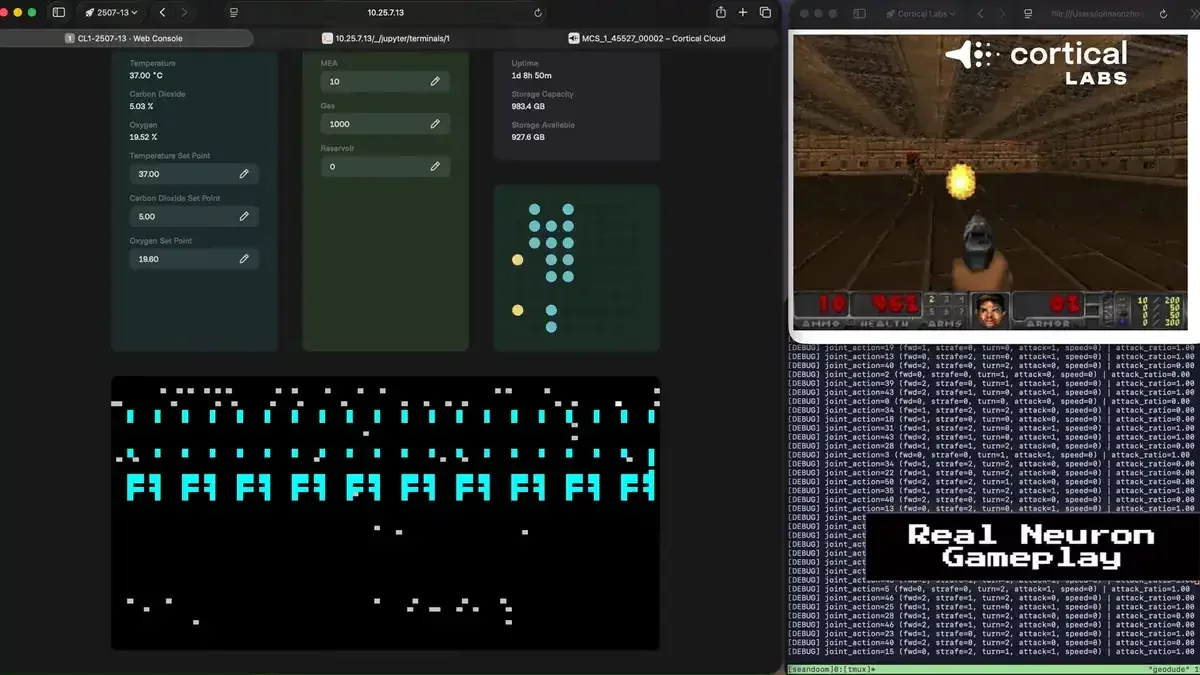
At first glance, it may appear to be just another nostalgic gaming session reminiscent of the 1990s. However, the true marvel lies in the players: human neurons cultivated on a chip are now engaging with the classic game Doom.
Researchers from the Australian start-up Cortical Labs have successfully trained 200,000 neurons to navigate the challenges of Doom, a significant advancement from their previous achievement in 2021, where they utilized 800,000 neurons to play Pong. Remarkably, this latest feat was accomplished with a fraction of the brain cells, showcasing the neurons' capability to tackle more complex tasks.
The innovation is further enhanced by the "Cortical Cloud," an interface enabling developers to program these neurons using Python. Independent researcher Sean Cole demonstrated this by teaching the cells to play Doom in just one week.
Why Neurons Excel
While conventional chips can execute trillions of operations per second, biological neurons offer an unparalleled advantage in terms of efficiency. The human brain, operating on a mere 20 watts of power--similar to a dim lightbulb--outperforms silicon supercomputers, which would require extensive energy and cooling systems to replicate even a fraction of its capabilities.
Silicon technology is rigid, executing commands rapidly without consideration for outcomes. In contrast, biological neurons are inherently curious, having evolved over billions of years to solve problems using minimal energy.
The CL-1, a groundbreaking "biological computer" chip, integrates human neurons derived from induced pluripotent stem cells (iPSCs), which are reprogrammed from adult skin or blood samples into functional cortical neurons. Once matured, these neurons are placed on a high-density microelectrode array (HD-MEA), creating a silicon chip with thousands of connection points.
This innovative chip serves as a conduit between the neurons and the digital world. The neurons adapt through synaptic plasticity, restructuring their connections to optimize performance and effectively learning to navigate the game.
Programming this biological computer diverges from traditional coding. Instead of rigid instructions, the process involves supervised sensory feedback, allowing neurons to naturally seek order and adapt.
Wetware vs Hardware
Unlike silicon-based AI, which relies on extensive training datasets, these neurons exhibit "adaptive real-time goal-directed learning." They learn through experience rather than requiring vast amounts of data. The neurons respond to electrical pulses representing the game state, enabling them to make decisions based on feedback.
The biological chip may not be a gaming powerhouse, but its development marks a significant step toward solving complex tasks that traditional chips struggle with, such as controlling robotic arms with high precision.
Ethical Considerations
While Dr. Brett Kagan, Chief Scientific Officer at Cortical Labs, emphasizes that these neurons are not "mini-brains," the ethical implications of using living cells in computing are profound. As technology advances, questions about ownership and the nature of consciousness in biological computing will become increasingly relevant.
Ultimately, we may have found a way not just to mimic human thought but to integrate human biological elements into the realm of computing.