Every interaction with AI, such as querying ChatGPT, initiates a complex relay of data. This process involves the movement of information from memory to the CPU for initial processing, followed by a trip to the GPU for intensive computation, and then back again. This repeated journey highlights a significant bottleneck in current AI architecture.
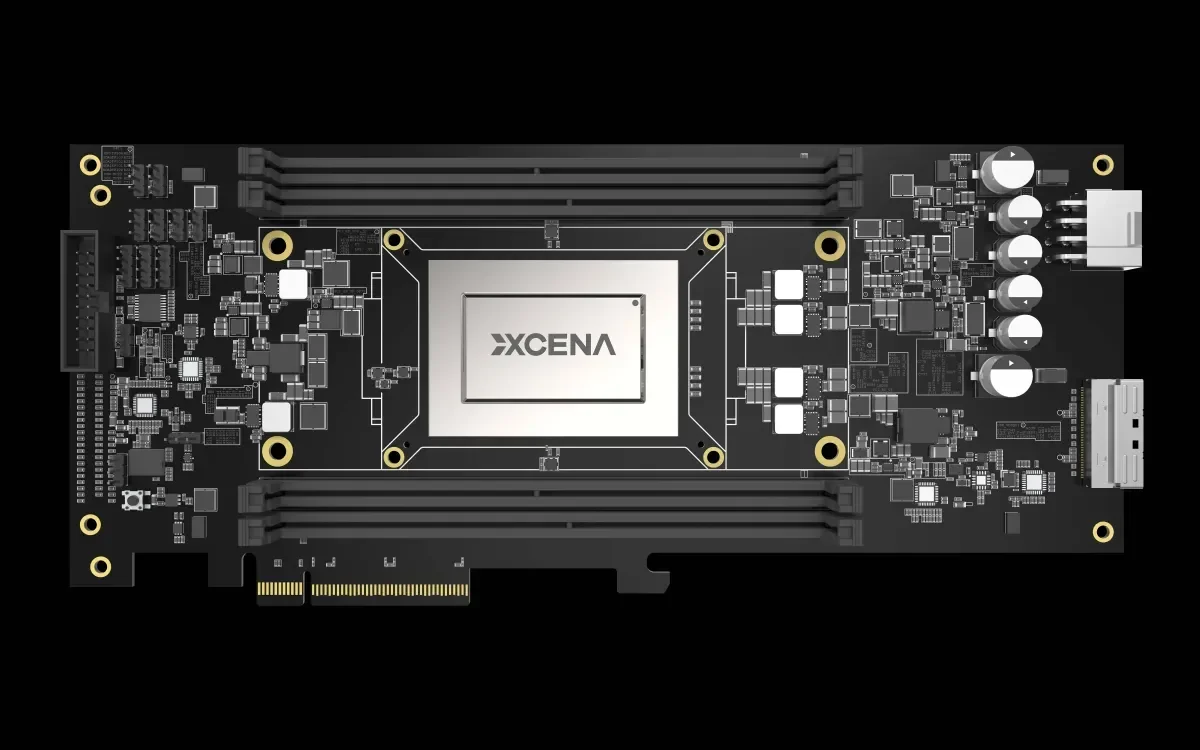
Addressing this challenge is XCENA, a promising startup with operations in South Korea and the United States. Founded four years ago, XCENA has developed a chip designed to bring computational capabilities closer to DRAM, the high-speed memory responsible for storing active data. This innovation allows for more efficient data operations by minimizing the costly back-and-forth between CPUs, GPUs, and memory.
Recently, XCENA raised an impressive $135 million in a Series B funding round, achieving a valuation of $570 million and bringing its total funding to $185 million. This surge in investment underscores the growing interest in optimizing AI infrastructure costs.
CEO Jin Kim, alongside co-founders Dohun Kim and Harry Juhyun Kim, all seasoned professionals from Samsung and SK Hynix, believes that while CPUs and GPUs have evolved, memory technology has lagged behind. "Our goal is to transform this landscape," Kim noted in a recent interview. The rising prices of memory and related stocks signal a shift towards memory-centric AI architectures, especially as leading memory manufacturers like Samsung, SK Hynix, and Micron recently reached trillion-dollar valuations.
XCENA posits that "inference isn't merely a computational hurdle; it's increasingly a challenge of memory scalability," according to Kim. Their MX1 chip connects directly to the CPU via CXL (Compute Express Link), creating a streamlined pathway for processing data without requiring it to leave the memory module. This advancement could enable operations that previously necessitated ten servers to run on just one.
While GPUs are adept at handling matrix multiplication for AI training, many surrounding tasks, such as data orchestration and caching, still rely heavily on CPUs. The MX1 chip addresses these tasks directly within the memory module, enhancing efficiency.
As the demand for innovative memory solutions continues to rise, XCENA is poised to benefit from favorable market conditions. The startup is currently in preliminary discussions with several global memory vendors, targeting hyperscalers that invest heavily in AI infrastructure, where even minor improvements in memory efficiency can yield substantial savings.
Though the MX1 is still in the prototype phase, mass production is anticipated to commence at Samsung's foundries by late 2026, with revenue projections starting in 2027.
As competition intensifies among neural processing unit makers, XCENA focuses on enhancing the foundational memory layer critical for AI applications. Competing with established players like Astera Labs and Marvell, XCENA differentiates itself through its unique intellectual property and innovative core design.
With a team of over 90 employees, XCENA continues to explore additional funding opportunities while solidifying its position in the rapidly evolving landscape of AI technology.