Recent research combining brain imaging techniques with artificial intelligence has unveiled fascinating insights into how infants perceive and learn about their environment during their initial months. These findings shed light on the cognitive processes occurring in a baby's brain long before they can speak or move purposefully.
A team from Trinity College's Institute of Neuroscience and School of Psychology published the study in the esteemed journal Nature Neuroscience.
Exploring the Cognitive World of Infants
"For years, both parents and researchers have been curious about the thoughts and perceptions of babies as they observe the world. This research underscores the complexity of brain activity during the first year of life," states Dr. Cliona O'Doherty, the lead author, who conducted the study at Trinity's Cusack Lab.
"At just two months old, although infants lack the ability to communicate verbally or control their movements, they are already categorizing visual stimuli. This indicates that the groundwork for visual cognition is established much earlier than previously thought."
Investigating Awake Infants Through Brain Imaging
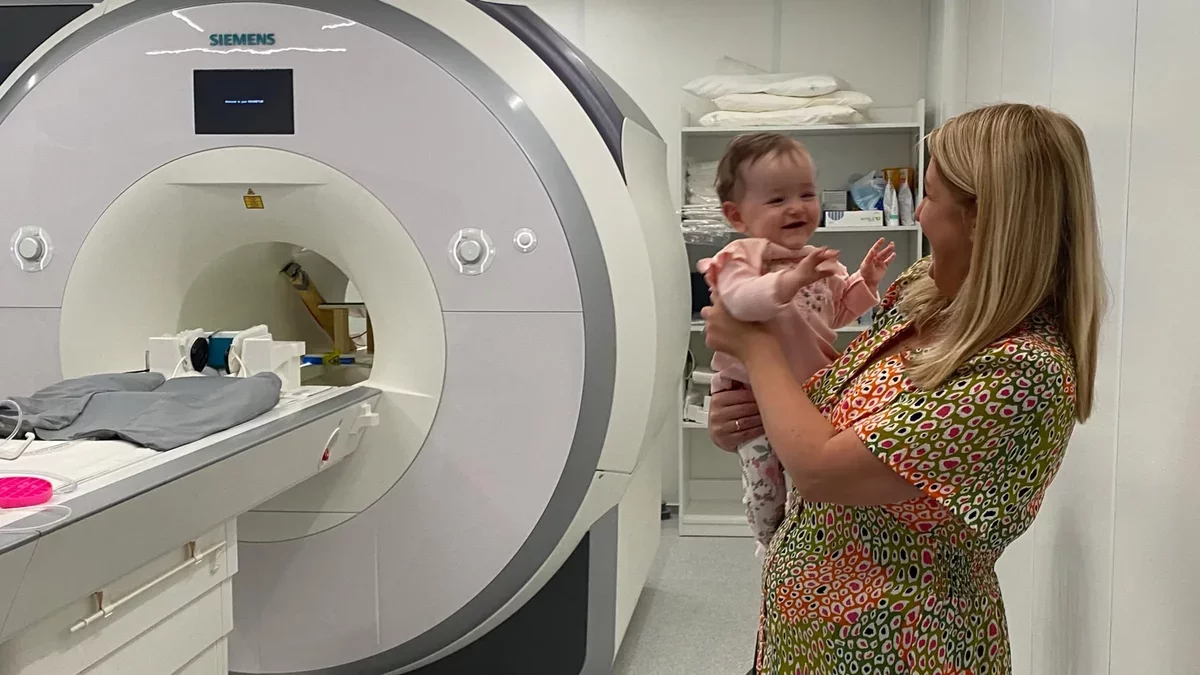
Collaborating with Dublin's Coombe and Rotunda Hospitals, the FOUNDCOG team engaged 130 two-month-old infants. Each baby was comfortably positioned on a soft beanbag, equipped with sound-canceling headphones, and shown vibrant images meant to captivate their attention for 15-20 minutes.
This arrangement enabled researchers to utilize functional MRI (fMRI) to capture brain activity patterns as the infants viewed images from 12 familiar categories, including cats, birds, rubber ducks, shopping carts, and trees.
The Role of Artificial Intelligence in Understanding Brain Activity
After gathering the brain scans, the team employed artificial intelligence models to analyze how visual categories were represented in the infants' brains. By comparing activity patterns in both the AI models and the babies' brains, they gained deeper insights into early categorization processes.
"This study marks the largest longitudinal investigation using fMRI on awake infants. The extensive dataset of brain activity opens new avenues for measuring infants' thoughts at a very young age. It also highlights the potential of neuroimaging and computational models as diagnostic tools for young children," remarks Rhodri Cusack, team leader and Professor of Cognitive Neuroscience at Trinity.
"Babies learn at a pace far surpassing that of contemporary AI models, and by examining their learning processes, we aim to inspire a new generation of AI systems that are more efficient, thereby reducing economic and environmental impacts."
The Significance of These Discoveries Beyond Research
Dr. Anna Truzzi, now at Queen's University Belfast and a co-author of the paper, emphasized the importance of recent technological advancements that made this research possible. "Until now, reliably measuring how specific areas of an infant's brain interpret visual information was a challenge. Our study, which merges AI and neuroimaging, provides unique insights into how babies learn in their formative year."
"The first year is crucial for rapid and complex brain development. This research lays foundational knowledge that can inform early education, provide clinical support for neurodevelopmental conditions, and inspire more biologically-informed approaches in artificial intelligence."
Professor Eleanor Molloy, a neonatologist at Children's Health Ireland and co-author, highlighted the broader implications of this work. "Understanding how neurodevelopmental disorders affect early brain development is vital, and awake fMRI holds significant promise in this area."
Dr. O'Doherty is currently affiliated with Stanford University, while Dr. Anna Truzzi serves as a Senior Lecturer at Queen's University Belfast.