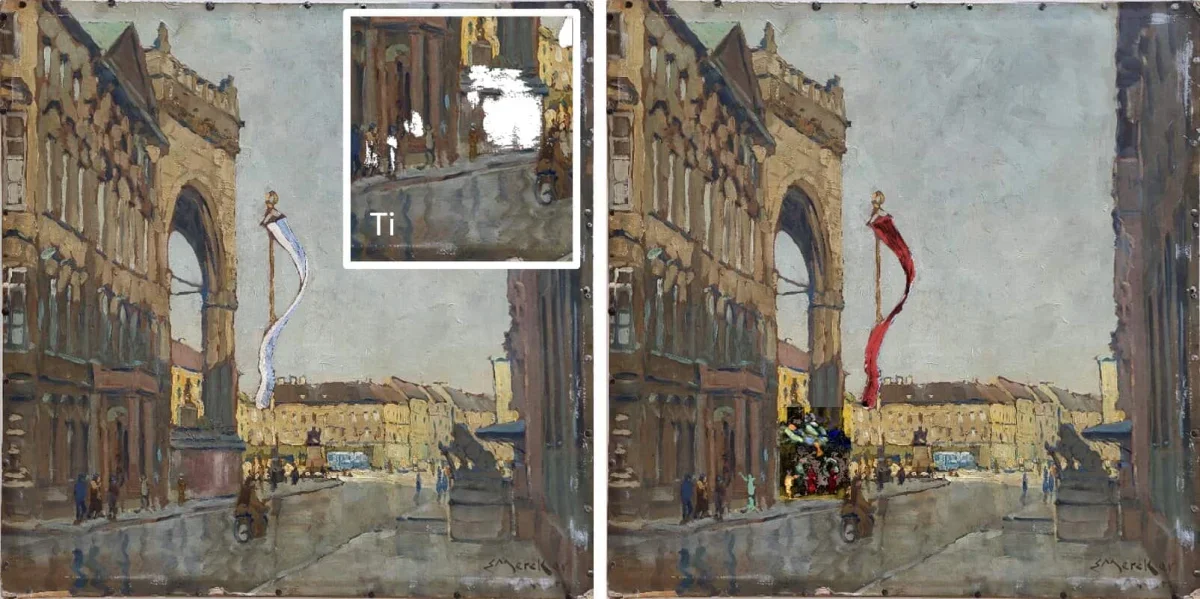
What initially appears to be a charming depiction of Munich's Odeonsplatz has revealed a deeper narrative through advanced X-ray fluorescence analysis. The artwork, showcasing a blue-and-white Bavarian flag, conceals a significant historical truth beneath its surface.
Upon closer inspection, researchers identified remnants of a red Nazi flag lurking beneath the painted Bavarian flag. This discovery connects to a memorial that was dismantled shortly after Germany's surrender in 1945. The original painting, created by Erich Mercker, a lesser-known artist who thrived during the Nazi regime, underwent a transformation post-war as its more controversial elements were obscured.
The Artist Behind the Alteration
Mercker's career flourished under the Third Reich, producing over 3,000 works predominantly featuring landscapes and cityscapes. His participation in the Great German Art Exhibitions and substantial earnings from the Nazi government highlight his integration into the regime's artistic landscape.
One of Mercker's notable themes was the "Site of November 9," referencing a failed coup attempt by Adolf Hitler in 1923. This event, which led to significant casualties, was later transformed into a symbol of martyrdom by the Nazi regime.
After the war, many artists, including Mercker, sought to distance themselves from their past. In a clever maneuver, Mercker altered his painting, replacing the Nazi flag with a Bavarian one and erasing the soldiers and memorials, effectively sanitizing his work for the new era.
The painting in question remained hidden in a private collection until filmmaker Thomas Schuhbauer noticed its discrepancies and reached out to experts at Helmholtz-Zentrum Berlin and Technische Universität Berlin.
Innovative Analysis Techniques
The research team employed X-ray fluorescence, a non-invasive method that allows for the examination of layers beneath the paint without damaging the artwork. This technique revealed the presence of cadmium and selenium, indicating the original red hue of the Nazi flag beneath the blue-and-white facade.
Further analysis uncovered hidden elements, including wreaths and raised arms in salute, which were painted over in an attempt to erase their historical significance. The study suggests that the painting was created in 1934 and later modified between 1945 and 1966.
Implications of the Discovery
While the study does not definitively identify who altered the painting, it leans towards the possibility that Mercker himself performed the revisions. The visible remnants of the original imagery suggest a hasty cover-up rather than a complete erasure of the past.
This artwork now resides in the Munich Documentation Centre for the History of National Socialism, serving as a poignant reminder of the complexities of history and the narratives that art can conceal.
The insights gained from this analysis not only enhance our understanding of historical art but also underscore the importance of preserving and interpreting cultural artifacts in a way that acknowledges their full context.