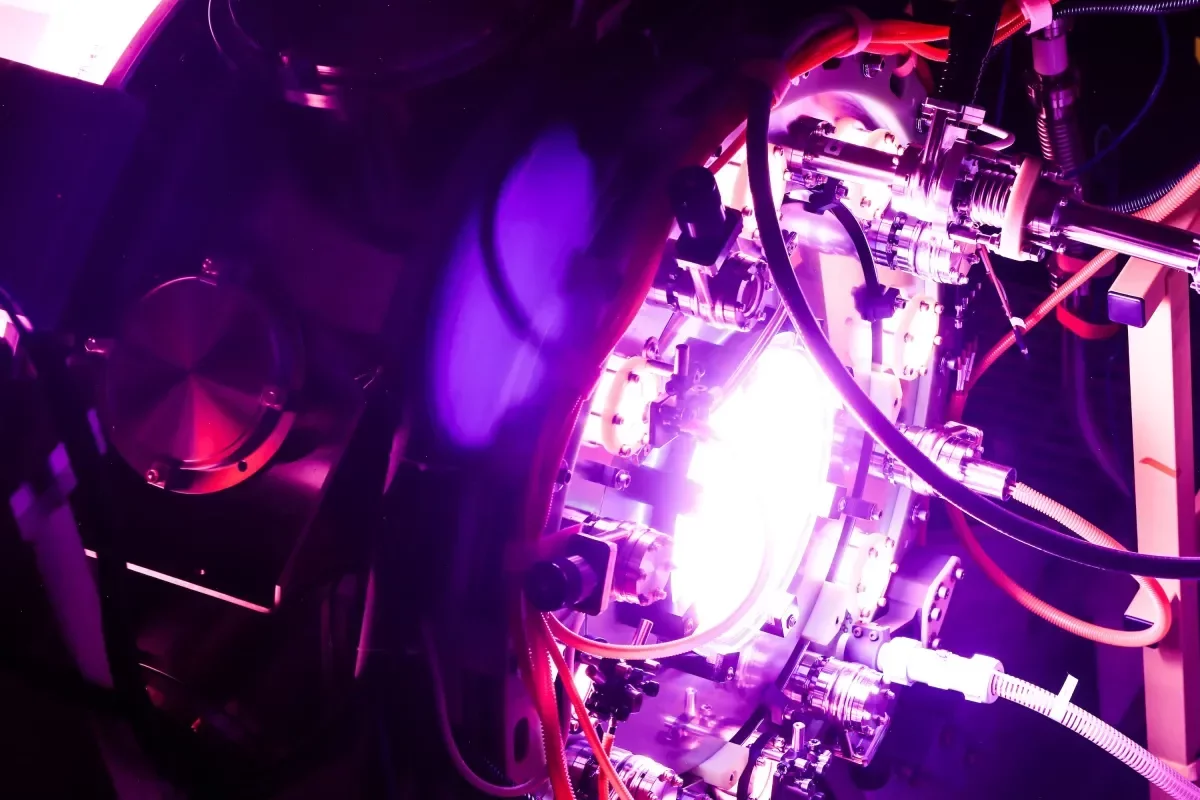
Helion, a fusion energy startup based in Everett, Washington, has announced a significant advancement in its pursuit of sustainable fusion power. The company revealed that the plasmas within its Polaris prototype reactor have reached an impressive temperature of 150 million degrees Celsius, moving closer to the necessary conditions for operating a commercial fusion power plant.
"We're thrilled to have reached this milestone," said David Kirtley, co-founder and CEO of Helion, in a statement.
Polaris operates using a deuterium-tritium fuel mix, making Helion the first fusion company to utilize this combination. Kirtley noted that they observed a substantial increase in fusion power output, evident in the heat generated.
Helion is competing with several other companies aiming to commercialize fusion energy, which is seen as a potentially limitless source of clean power.
This potential has attracted significant investment in the technology. Recently, Inertia Enterprises announced a $450 million Series A funding round, with participation from notable investors. Earlier this year, Type One Energy shared its plans to raise $250 million, while Commonwealth Fusion Systems secured $863 million last summer from investors including Google and Nvidia. Helion itself raised $425 million last year from a group of investors.
While many fusion startups are aiming for the early 2030s to deliver electricity, Helion has a contract with Microsoft to supply energy starting in 2028, which will come from a larger reactor named Orion, currently under construction.
Each fusion startup has unique milestones, with Commonwealth Fusion Systems requiring its plasmas to exceed 100 million degrees Celsius in its tokamak design. However, Helion's reactor demands even higher plasma temperatures to achieve optimal performance.
The design of Helion's reactor features a field-reversed configuration, resembling an hourglass. Fuel is injected at the wider ends, transformed into plasmas, and then accelerated toward one another. The initial fusion occurs at temperatures between 10 million and 20 million degrees Celsius, with powerful magnets compressing the fusion ball to reach 150 million degrees in less than a millisecond.
Instead of extracting energy through heat, Helion harnesses the magnetic field generated by the fusion reaction to produce electricity. This innovative approach aims to enhance efficiency compared to traditional methods.
In the past year, Kirtley mentioned that improvements have been made to the reactor's circuits to increase electricity recovery.
Currently utilizing deuterium-tritium fuel, Helion plans to transition to deuterium-helium-3 in the future. This choice is expected to generate more charged particles, enhancing the efficiency of electricity generation.
Helion aspires to achieve plasmas reaching 200 million degrees Celsius, which Kirtley believes is the optimal operating temperature for a power plant.
When questioned about reaching scientific breakeven, Kirtley emphasized their focus on electricity generation rather than purely scientific milestones.
Helium-3, which is abundant on the Moon but scarce on Earth, will be produced by Helion through initial deuterium fusion. The company plans to recycle helium-3 produced during deuterium-deuterium reactions.
Efforts to refine the fuel cycle are already in progress, with Kirtley expressing satisfaction at the ease of implementing the necessary technology. Helion has achieved high efficiency in producing helium-3.
Although Helion is currently the only fusion startup using helium-3, Kirtley anticipates that others will follow suit, suggesting a willingness to supply helium-3 to interested companies.
In addition to its work with Polaris, Helion is developing Orion, a 50-megawatt fusion reactor essential for fulfilling its contract with Microsoft. Kirtley stated, "Our ultimate goal is not just to build and deliver Polaris; it is a step towards larger-scale power plants."