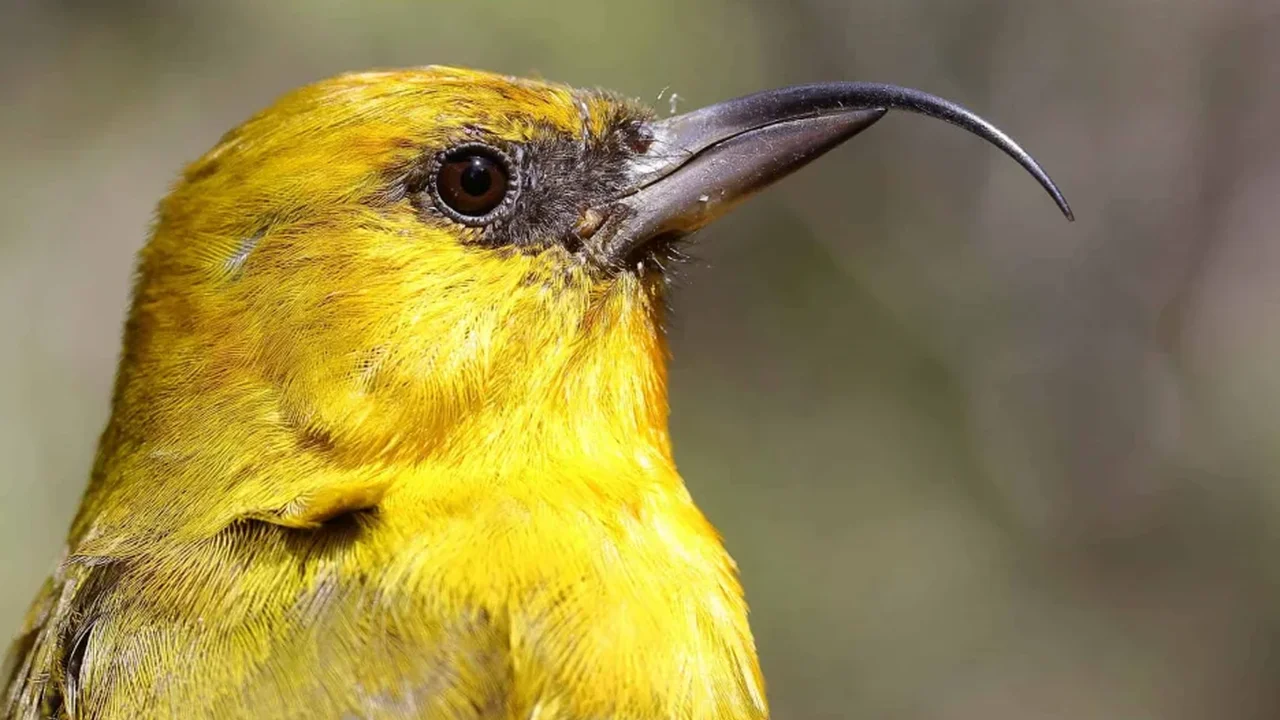
Hawaii's ʻakiapōlāʻau has evolved a distinctive way to find food hidden inside wood. A new study suggests that, alongside its unusual beak, the small bird may use its legs and ankles to add force to each strike.
A beak with two jobs
Unlike woodpeckers, which do not naturally occur in Hawaii, the ʻakiapōlāʻau uses a two-part bill to reach insect larvae. Its sturdy lower bill chips into wood, while its long, flexible upper bill probes the opening for prey.
The upper bill's bony core is about 38% shorter than its outer keratin covering, giving its tip the flexibility to explore narrow spaces. The bird first taps along a branch, then opens its bill and repeatedly drives the lower part into a promising spot. Once an opening forms, it searches inside with the upper bill.
Power from the feet
Researchers led by evolutionary biologist Alexander Clark examined three museum skeletons and compared them with mainland finches. They found that the ʻakiapōlāʻau has a short, sturdy thigh bone and an unusually prominent attachment for a muscle that bends the ankle.
These features may help the bird stay stable on branches and flex its ankles forcefully as it strikes. Rather than relying mainly on its head and neck, as woodpeckers do, the ʻakiapōlāʻau may bring more of its body into the motion--much like swinging a small axe.
The study, published in Ornithology, describes an example of convergent evolution: different animals developing distinct adaptations to meet similar challenges. The ʻakiapōlāʻau's specialized feeding behavior also takes practice; young birds can remain with their parents for four to five months as they learn to forage.
By revealing how anatomy and behavior work together, this research may help scientists better understand the many ways evolution equips animals to thrive in specialized environments.