Google DeepMind and Google Research have introduced WeatherNext 3, a new AI weather model designed to read atmospheric patterns with greater detail and speed. The system is now being woven into Google Search, Google Maps and Gemini, while also opening to users and researchers through Google Cloud.
The model has already ranked as the strongest performer in tests on Operational WeatherBench, a benchmark that compares AI forecasts across key measures such as temperature, wind speed and humidity. Google says it also outperformed several deep-learning systems from major tech and research teams, as well as traditional forecasting approaches.
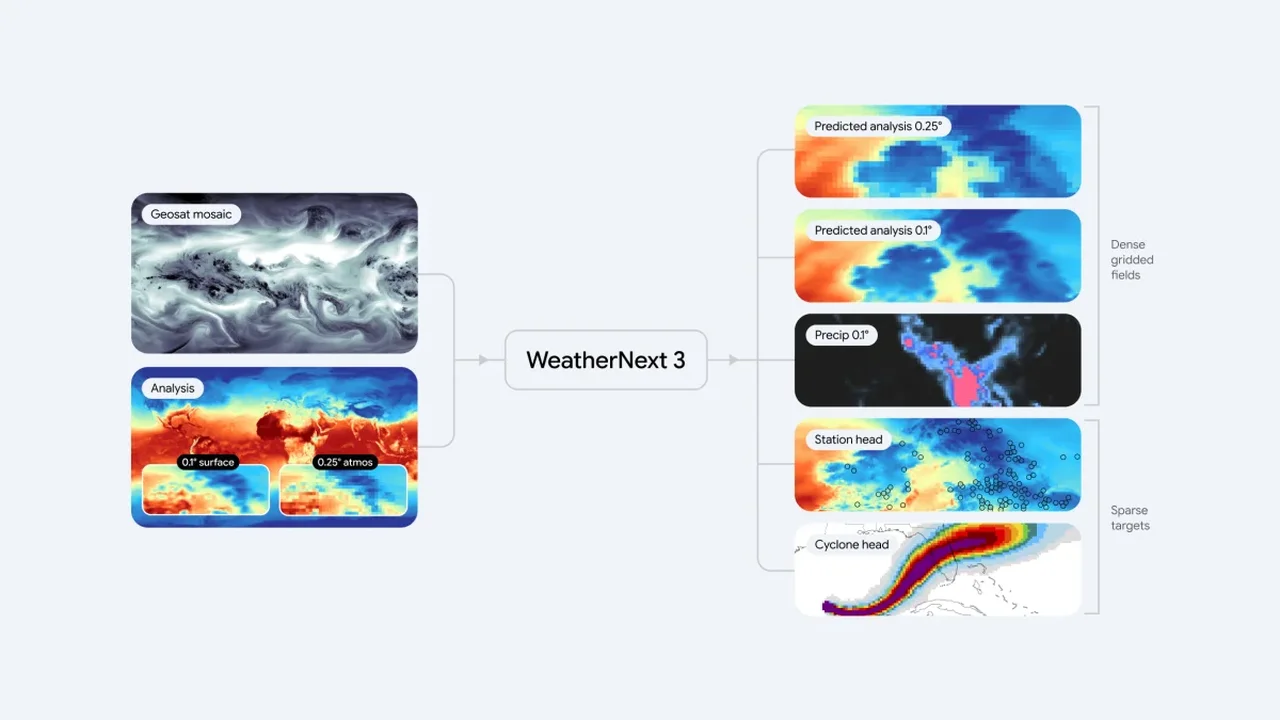
WeatherNext 3 marks a technical step forward in three areas: it can generate forecasts at a 5 km resolution, improves rain prediction by 60% compared with WeatherNext 2, and delivers hourly updates instead of six-hour intervals. The model is also larger than its predecessor, with 2.4 times more parameters.
Another notable shift is its use of real-time satellite observations and station-level targets, helping forecasts connect more closely to specific locations and ground-truth measurements. Researchers say this approach brings AI forecasting closer to end-to-end practical use.
Beyond consumer apps, the broader potential is significant. Faster and more affordable forecasting could support agriculture, renewable energy planning and regions where advanced weather infrastructure is limited. As AI continues to reshape meteorology, the next generation of forecasts may become more local, more frequent and more useful for everyday life.