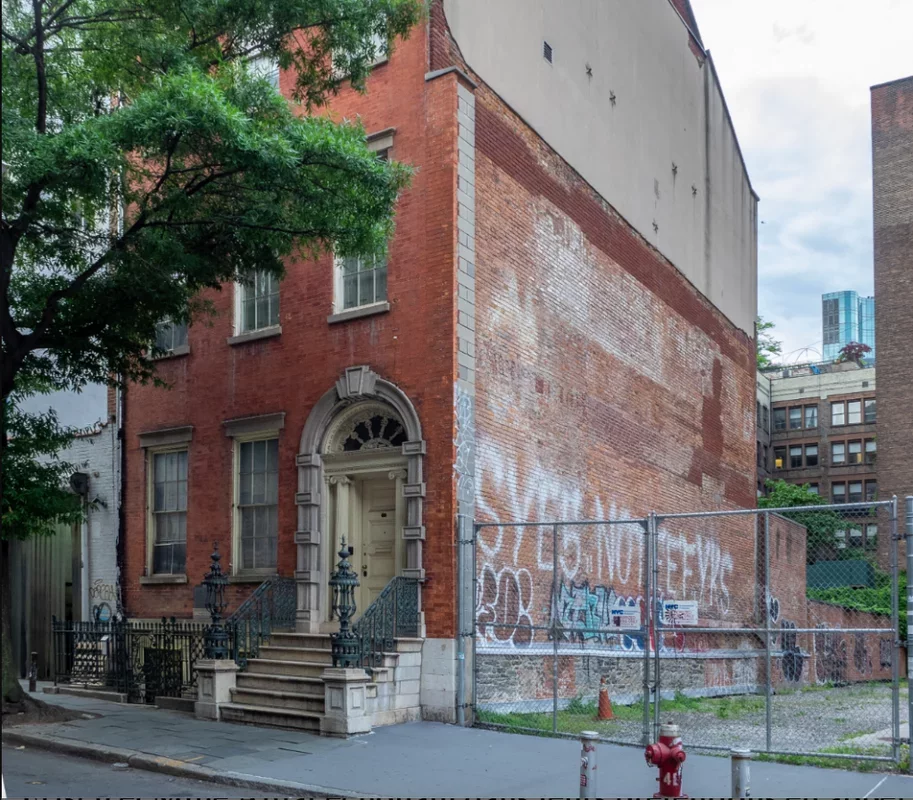
A historic residence in Manhattan, renowned for its insights into 19th-century life, has unveiled a remarkable secret. The Merchant's House Museum, a well-preserved site in the NoHo district, is believed to have once acted as a sanctuary for individuals fleeing slavery.
This revelation emerged during an examination of a built-in dresser located in a second-floor hallway. Archaeologists discovered a small rectangular opening beneath its drawers, leading to a hidden space approximately 2 feet by 2 feet, complete with a ladder descending to the lower level.
Experts suggest that this concealed passage may indicate the house's role as a "safe house" within the Underground Railroad, a covert network of abolitionists aiding enslaved individuals in their quest for freedom during the Civil War.
In that era, the threat of capture was ever-present. In the lead-up to the Civil War, bounty hunters, sometimes supported by civilians and law enforcement, pursued escaped individuals. The Fugitive Slave Act of 1850 permitted them to chase down those who fled, even in the northern states, offering monetary rewards for their capture.
Camille Czerkowicz, the museum's curator, remarked, "We knew it was here, but we didn't truly understand its significance," in an interview with NY1, which first broke the news.
Michael Hiller, a preservation attorney and Pratt Institute professor, described the find as "extraordinary," labeling it a "generational discovery" and one of the most important moments in his career. He stressed the necessity of preserving this space.
The Merchant's House was erected in 1832 by Joseph Brewster, a tradesman. Just three years later, it was acquired by the Tredwell family, who resided there for nearly a century before it transitioned into a museum.
Architectural historian Patrick Ciccone posits that Brewster himself likely constructed the hidden space, asserting that he was almost certainly an abolitionist. It remains uncertain whether the Tredwell family was aware of or utilized the secret passage.
"Being an abolitionist was exceedingly rare among affluent white New Yorkers," Ciccone explained. As the original builder, Brewster had the liberty to integrate such a feature into the home's architecture.
The building has long been acknowledged for its historical significance. It became Manhattan's first designated landmark in 1965 and was recognized as a National Historic Landmark in 1966, later being added to the National Register of Historic Places.
In recent years, the museum has confronted financial challenges and uncertainties regarding its future, particularly in light of plans for a new eight-story development on an adjacent lot.
City councilman Christopher Marte emphasized the importance of the discovery, stating, "Many New Yorkers forget that we were part of the abolitionist movement. This is physical evidence of what transpired in the South during the Civil War and underscores why that history remains relevant today."