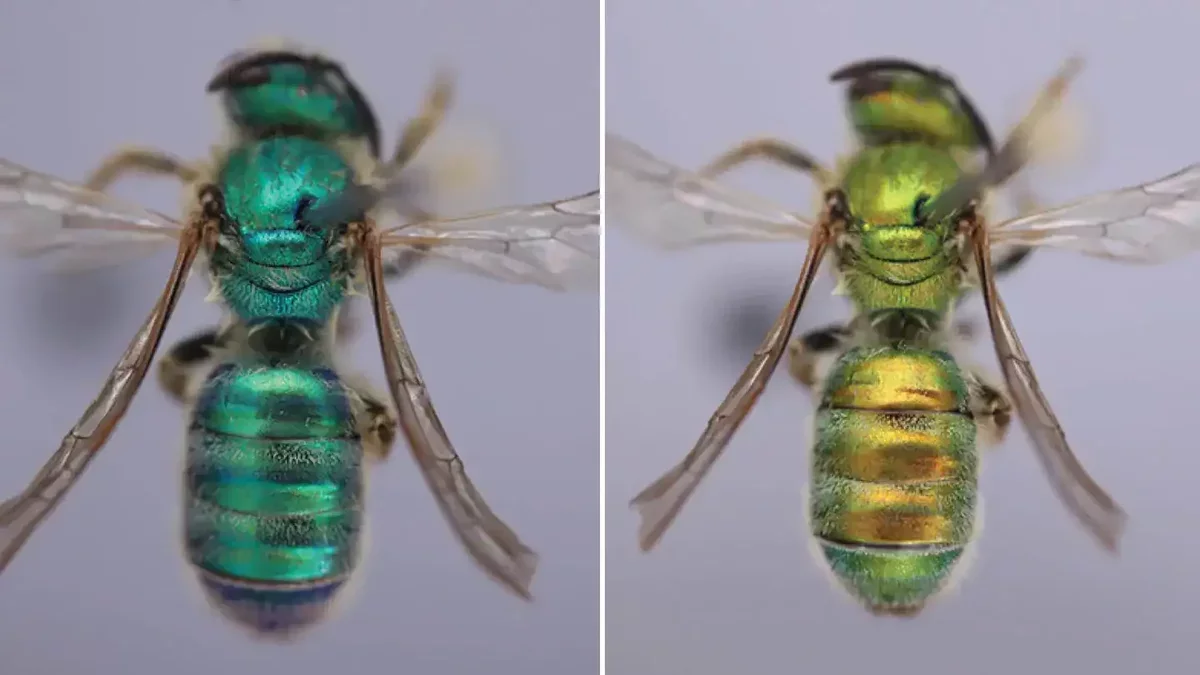
While a clear summer sky may seem devoid of life, it actually conceals a vibrant ecosystem bustling with trillions of insects, each navigating their daily routines. Among these creatures, the North American sweat bee, Agapostemon subtilior, has recently caught the attention of scientists due to its remarkable ability to change color in response to humidity, as detailed in a new study published in Biology Letters.
This fascinating research reveals that in low-humidity conditions, these bees exhibit a striking deep blue-green hue, while in high humidity, they transform into a lighter, coppery green. This color change is not an active adaptation, akin to a chameleon's camouflage, but rather a passive response of the bee's exoskeleton to moisture levels in the environment.
Dr. Madeleine Ostwald, a Lecturer in Ecology, Conservation & Biodiversity at Queen Mary University of London, emphasizes the diversity and vibrancy of bee species, stating, "When people think of bees, they often picture drab, brown honey bees. In reality, bees are incredibly diverse and colorful -- and we're only just starting to understand how their appearance reflects the climate they live in."
Understanding Structural Color
Typically, animal colors arise from pigments, such as the bright red of a cardinal or the orange of a tiger's fur. However, many of nature's most stunning colors are produced through nanostructures that manipulate light. For instance, the iridescent colors seen in Morpho butterflies and peacock feathers are due to microscopic features that reflect light in unique ways.
The study suggests that the color variations in A. subtilior are a result of tiny structural changes in their cuticle when exposed to different humidity levels. When moisture is absorbed, these structures swell slightly, altering the wavelengths of light reflected and thus changing the bee's appearance.
Ostwald notes, "Most people associate color change with animals like chameleons that actively control it. These bees aren't choosing to change color -- it's happening passively, simply in response to the humidity around them."
In their experiments, the researchers observed bees in two extreme humidity environments, capturing their color changes over 55 hours. The results were striking, with bees appearing medium green in normal humidity, shifting to orange-green in wet conditions, and turning bluer in dry air.
The Role of Museum Specimens
Interestingly, older museum specimens displayed a stronger color reaction to humidity than freshly collected bees. This finding highlights the importance of understanding how preserved specimens may not accurately represent an organism's living appearance, which is crucial for research in color adaptation and evolution.
Furthermore, the research team utilized the citizen-science platform iNaturalist to analyze photographs of wild bees, confirming that those in humid environments tended to exhibit the predicted color shifts. However, the study also noted that humidity is just one of many factors influencing bee coloration, alongside genetics and environmental conditions.
These findings open new avenues for understanding how climate influences the appearance of various bee species, potentially reshaping our knowledge of their evolutionary adaptations and ecological roles.