Across major art venues in New York, a new wave of exhibitions is showing how maps can do far more than describe territory. Through the work of Claudio Perna, Sandy Rodriguez, and Firelei Báez, cartography becomes a creative language for memory, migration, and cultural identity.
Perna, who was born in Milan and spent much of his life in Venezuela, treated maps as living documents rather than fixed records. His layered compositions combine photographs, clippings, and drawn interventions, turning geographic surfaces into spaces where belonging, movement, and social change can be read together. His practice suggests that a map can be personal, unstable, and deeply authored.
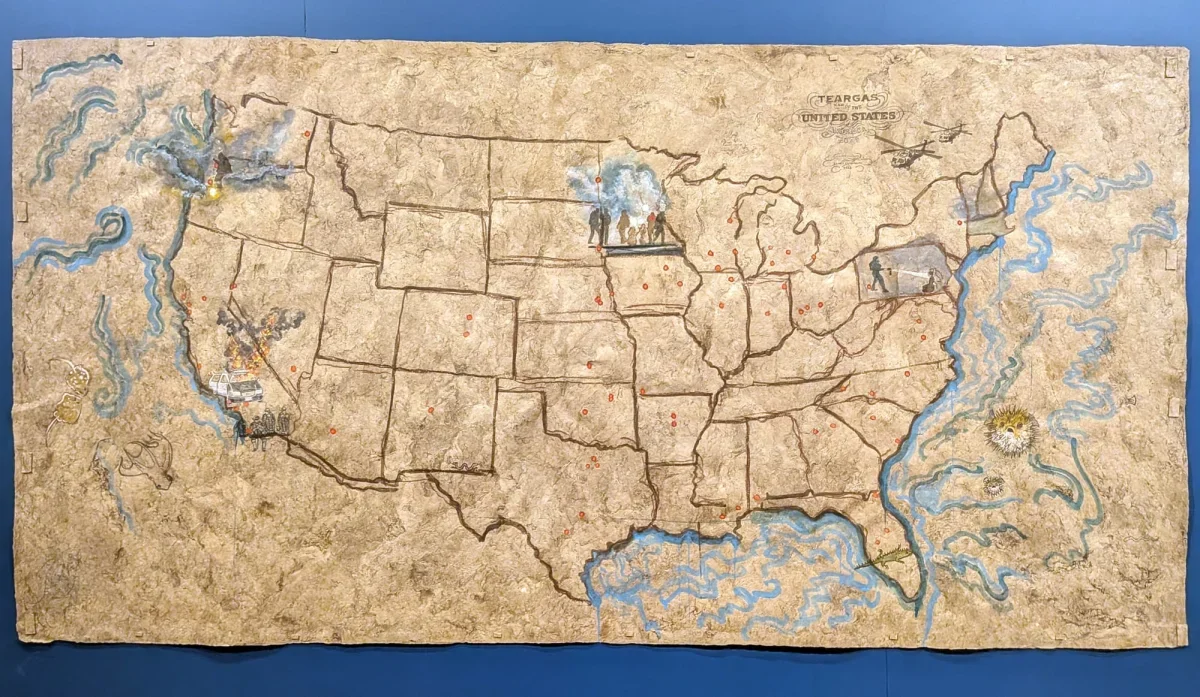
Rodriguez expands that idea in Tierra Insurgente at the Hispanic Society Museum & Library. Drawing on Indigenous visual traditions, she builds contemporary codices that place history, protest, myth, and environmental change in the same frame. Her works use hand-processed pigments and amate paper to create a visual archive that records both collective memory and present-day realities.
At Hauser & Wirth, Báez transforms 19th-century maps and diagrams into expansive paintings filled with plants, bodies, and mythic forms. By painting over colonial-era documents, she replaces rigid systems of measurement with layered, imaginative worlds shaped by diasporic memory and folklore. The result is a striking visual dialogue between inherited structures and new forms of seeing.
Together, these artists show that maps can be reworked into spaces of reflection, resistance, and reinvention. Their practices point toward a future where art helps us understand land not only as a boundary, but as a shared field of memory and possibility.