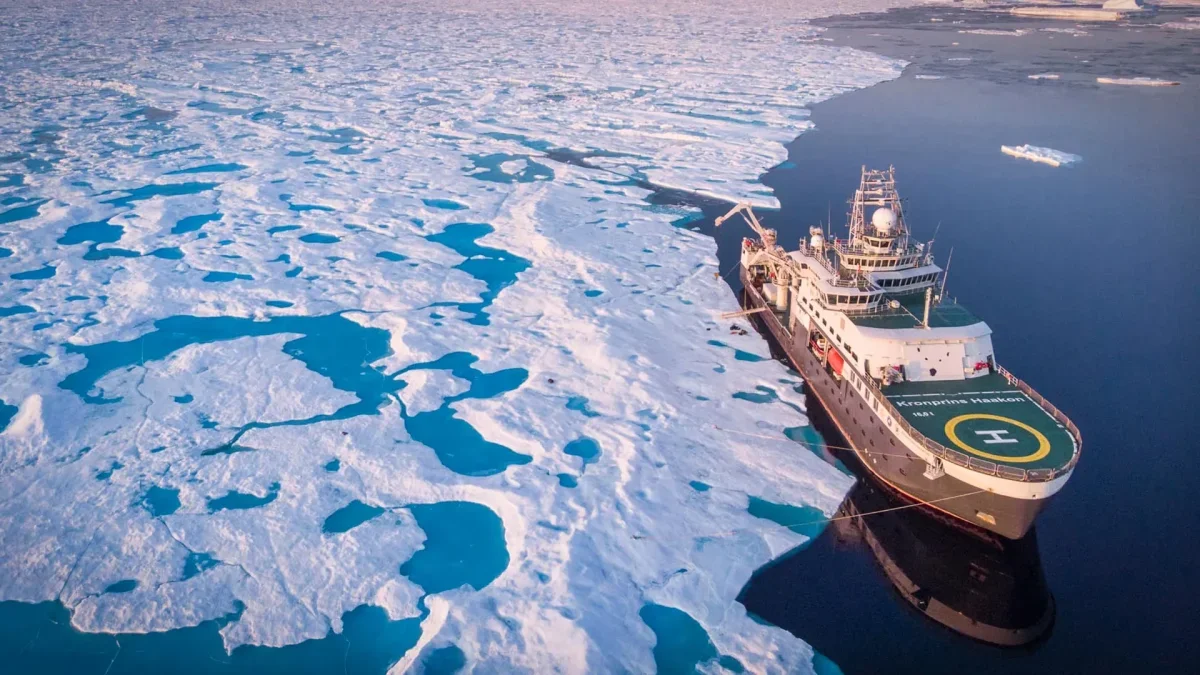
A recent study highlights a significant shift in the Arctic ecosystem, revealing that the rapid loss of sea ice has drastically decreased nitrate levels, a crucial nutrient for plankton growth. This decline poses potential risks to fish, seabirds, and marine mammals, while also diminishing the Arctic Ocean's capacity to absorb atmospheric carbon.
The research indicates that expansive areas of shallow Arctic waters, previously insulated by sea ice, are now receiving increased sunlight. This heightened exposure accelerates a natural process that depletes nitrate from seawater.
Declining Nitrate Levels in Arctic Waters
In an effort to understand the recent changes in Arctic wildlife populations, scientists from the University of Edinburgh analyzed over two decades of ocean sampling data from Fram Strait, a vital conduit where Arctic waters merge with the Atlantic Ocean. Their findings revealed a notable turning point around 2009, correlating with a significant increase in sea ice loss and a steady decline in nitrate levels in outgoing Arctic waters.
The research team concluded that the reduction in sea ice has intensified a process called benthic denitrification, where nitrate is converted into nitrogen gas in shallow seafloor areas, which constitute nearly half of the Arctic Ocean.
Smaller Plankton and a Weaker Food Chain
Experts caution that the nutrient-poor conditions may lead to a predominance of smaller plankton species in the future. This shift is concerning as smaller plankton typically support less productive food webs, resulting in diminished energy and food availability for larger marine species.
Moreover, this change could have repercussions beyond the Arctic region. As plankton play a vital role in sequestering carbon dioxide through photosynthesis, their reduced growth may weaken the ocean's ability to store carbon.
Given the ongoing decline of sea ice, researchers believe the Arctic Ocean is unlikely to revert to its previous state. Further investigations are essential to comprehend how these transformations may impact marine ecosystems in other regions, including the North Atlantic and critical commercial fishing areas.
The study's findings, published in the journal Communications Earth & Environment, received support from the Natural Environment Research Council (NERC) through its Changing Arctic Ocean project. Collaborating institutions included the Norwegian Polar Institute, Scottish Association for Marine Science, Technical University of Denmark, and Alfred-Wegener-Institut in Germany.
Marta Santos-García, a PhD student at the University of Edinburgh and co-leader of the study, emphasized, "Our findings indicate that the Arctic Ocean has transitioned from a system primarily constrained by light to one increasingly limited by nitrate availability, with significant implications for marine ecosystems, food chains, and the Arctic's role in Earth's climate."
According to Professor Raja Ganeshram, who led the study, "These changes suggest that the Arctic Ocean ecosystem surpassed a tipping point around 2009. Monitoring how this transition affects the food chain is crucial, as it holds profound implications for commercial fishing in the North Atlantic."