Iraqi artist Ali Eyal recalls a pivotal moment from his childhood when, at just nine years old, his mother took him and his siblings to an amusement park in Baghdad. She encouraged them to absorb the city's beauty from the Ferris wheel, an image that would soon be overshadowed by the chaos of war. Just days later, the United States initiated airstrikes, marking the onset of a conflict that would profoundly alter Eyal's life.
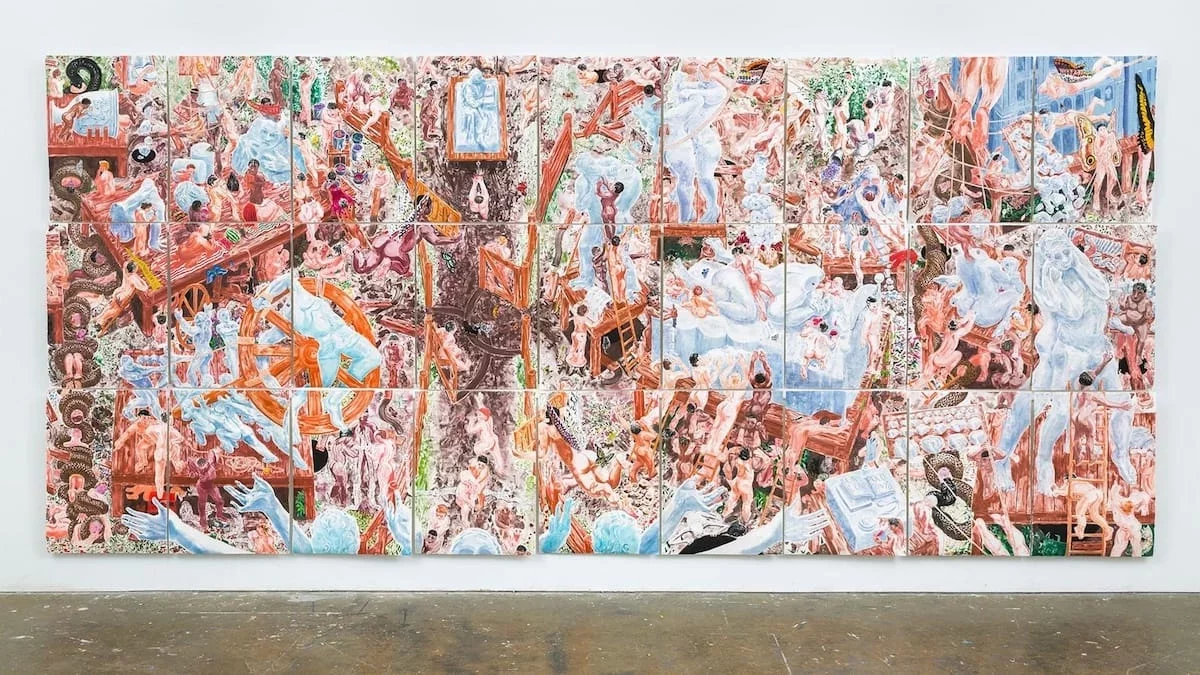
Reflecting on this memory, Eyal states, "As children, we didn't grasp the significance of that moment, but with time, its weight becomes clearer." This sentiment serves as the foundation for his latest oil painting, "Look Where I Took You" (2026), which makes its debut at the Whitney Biennial. The artwork presents a haunting scene where the Ferris wheel's cars morph into severed heads, and an armed guard oversees grotesque fairgoers, symbolizing the violence that engulfed his homeland.
In this piece, Eyal portrays himself as a child, grappling with the horrors unfolding around him. His artistic style encompasses painting, drawing, installation, and video, narrating a life steeped in trauma yet intertwined with childlike innocence. After leaving Baghdad nearly a decade ago, Eyal pursued his studies at the Institute of Fine Arts in Baghdad, then worked in Lebanon and France, eventually relocating to Los Angeles in 2022.
One of the most profound memories he explores is the disappearance of his father, who was taken by an Iraqi militia during the Arba'in pilgrimage. Eyal vividly recalls the day they stormed his home, believing they were there to protect the pilgrims. Instead, his father was kidnapped, leaving a void that Eyal has been attempting to fill through his art.
His works often delve into familial memories, as seen in "The Road to an Unknown Hand" (2024), where his family is depicted in a car on a treacherous journey. In "Please Look Where They Took Us" (2026), his oversized father points to the remnants of a bombed vehicle, a tragic foreshadowing of their fate. Eyal's pieces are often accompanied by narrative texts that blend truth with fiction, inviting viewers to engage with his experiences empathetically.
Incorporating beauty amidst the heaviness, Eyal captures tender moments, like a hand presenting a moldy orange, symbolizing his mother's ability to find enchantment in decay. His art, illuminated by vibrant sunsets, carries the duality of beauty and darkness, as these colors are reminiscent of the violence that often occurred at dusk.
Despite the therapeutic role of art in Eyal's life, the shadow of past traumas remains. As recent events echo the conflicts of his childhood, Eyal expresses a desire for peace, hoping for a future free from the specter of war for his family.