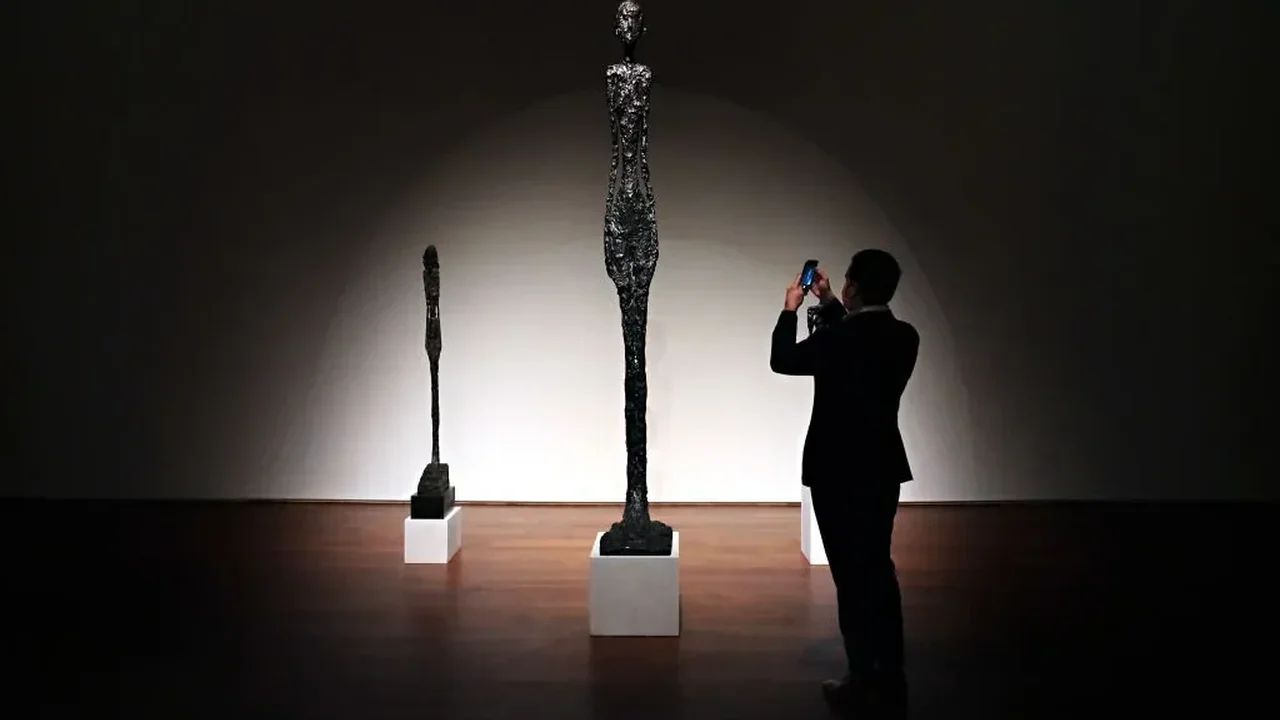
Alberto Giacometti remains one of the defining names in modern sculpture, with his elongated figures and striking portraits continuing to command exceptional attention at auction. Born in Switzerland in 1901, the artist developed a visual language that moved from early Surrealist experiments to the sparse, emotionally charged forms that made his postwar work instantly recognizable.
His market strength has only deepened over time. Major museums and private collectors continue to compete for rare bronzes and paintings, pushing several works into the highest tiers of the global art market. The artist's auction history reflects both the scarcity of his most important pieces and the lasting appeal of his vision.
Key Auction Milestones
L'Homme au doigt led the list with a record-setting $141.3 million at Christie's in New York in 2015, still the highest price ever paid for a Giacometti at auction. Chariot followed with $100.97 million at Sotheby's in 2014, while Walking Man I reached £65 million ($104.3 million) in London in 2010, briefly becoming the most expensive artwork ever sold at auction.
Other major results include Le Nez at $78.4 million, Grande tête mince at $53.3 million, and Grande tête mince (Grande tête de Diego) at $50 million. Giacometti's rare paintings also perform strongly, with Diego en chemise écossaise reaching $32.6 million. Sculptures such as Trois hommes qui marchent, Grande femme II, and Femme Leoni further show how consistently his work resonates with collectors.
Across these results, one pattern stands out: Giacometti's art continues to bridge emotional intensity, historical importance, and market prestige. As interest in landmark modern works remains strong, his legacy is likely to keep shaping the future of high-end collecting.