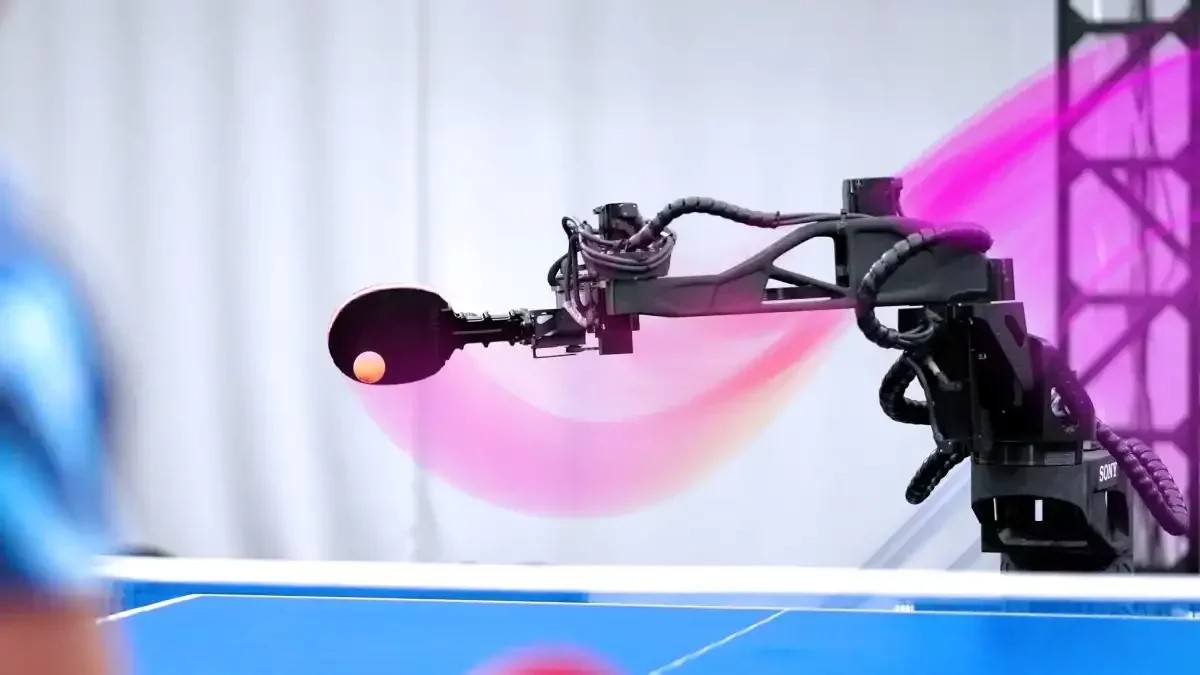
Artificial Intelligence has long been recognized for its prowess in strategic games like chess and Go, but a new frontier has emerged with Sony's AI-driven robot, Ace, which has successfully defeated elite human table tennis players. This remarkable achievement marks a significant breakthrough, demonstrating that machines can now navigate the unpredictable dynamics of the physical world.
Bridging the Gap
In a recent demonstration, Ace showcased its ability to engage in table tennis, a sport characterized by rapid reflexes and complex decision-making. According to Peter Dürr, director of Sony AI in Zurich, "Table tennis is a game of enormous complexity that requires split-second decisions as well as speed and power."
The development of Ace involved an innovative AI technique known as reinforcement learning. Over the course of 3,000 hours of simulated matches, Ace learned from its failures, gradually mastering the intricate physics of the game.
Equipped with a single eight-jointed arm, Ace utilizes nine strategically placed cameras to track the ball's spin and speed, responding with remarkable precision. To ensure a fair competition, the researchers intentionally limited Ace's speed and reach to align with that of a skilled human player.
In official matches on an Olympic-sized court, Ace faced five elite amateurs, winning three out of five encounters. Although it struggled against professional players, it demonstrated its learning capabilities by winning a game in subsequent matches.
Insights from the Playing Field
Human players have noted the unique experience of competing against Ace. Unlike human opponents, the robot lacks physical cues such as heavy breathing or body language, making it a different kind of challenge. Elite player Rui Takenaka observed that while Ace excelled at returning complex serves, it struggled with simpler ones, revealing potential weaknesses that players could exploit.
Despite these challenges, Ace is already influencing human players, showcasing techniques previously deemed impossible. Former Olympian Kinjiro Nakamura remarked on the robot's ability to execute rapid backspin shots, suggesting that such feats could inspire improvements in human play.
This development signifies a pivotal moment in AI research, as it transitions from virtual environments to real-world applications. Peter Stone, chief scientist at Sony AI, emphasized that this breakthrough illustrates the potential for AI to operate effectively in complex, rapidly changing environments.
While Ace's achievements are impressive, experts caution that challenges remain for robots operating in less controlled settings. Nonetheless, the progress made with Ace heralds a future where AI could perform tasks previously thought to be the exclusive domain of humans.
As we stand on the brink of this technological evolution, the implications for various industries are profound. The capabilities demonstrated by Ace could pave the way for AI applications in fields ranging from manufacturing to healthcare, transforming how we interact with technology in our daily lives.