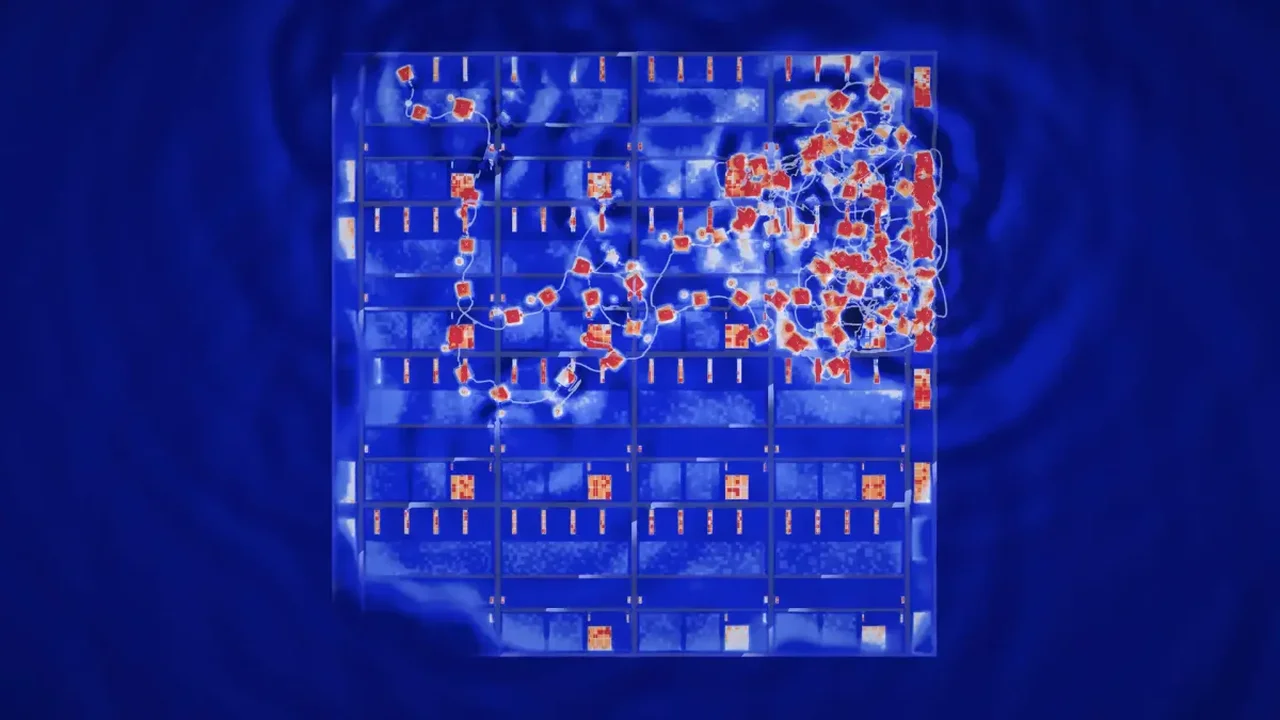
An experimental processor designed with substantial help from AI agents could offer a different path to more energy-efficient computing. Called Frostbite, the chip uses an architecture that organizes calculations to run in parallel while reducing the coordination and data movement that consume power in conventional processors.
Developed by Palo Alto-based Architect Labs, Frostbite is built around interaction nets, a model that represents programs as connected operations rather than a sequence of instructions. Its small processing units, or tiles, have local memory and can share work when one unit is busy and another is idle. An idle tile can also power down when it has no work.
AI agents contributed to exploring and testing design options. According to the company, they assessed 58 possible improvements and retained 37. The agents also arrived at a way for tiles to redistribute tasks, a technique known as work stealing, without that behavior being explicitly specified by the human team.
Promising results, with testing still ahead
In simulations based on a 7-nanometer manufacturing process, a four-tile Frostbite configuration delivered 4.59 times the performance per watt of a conventional processor core of similar size. Across 15 workloads not used during design optimization, it recorded a 3.83-fold advantage, though results varied by task.
These are simulated comparisons, not results from a manufactured chip. Architect Labs has not publicly named the processor used as a benchmark, and Frostbite has yet to undergo physical production or real-world software testing. The figures therefore do not establish that it outperforms current desktop or server CPUs.
If future hardware tests confirm the simulations, Frostbite's approach could help make computing more efficient by doing more work with less energy. For now, it offers a glimpse of how AI-assisted design may broaden the possibilities for processor architecture.