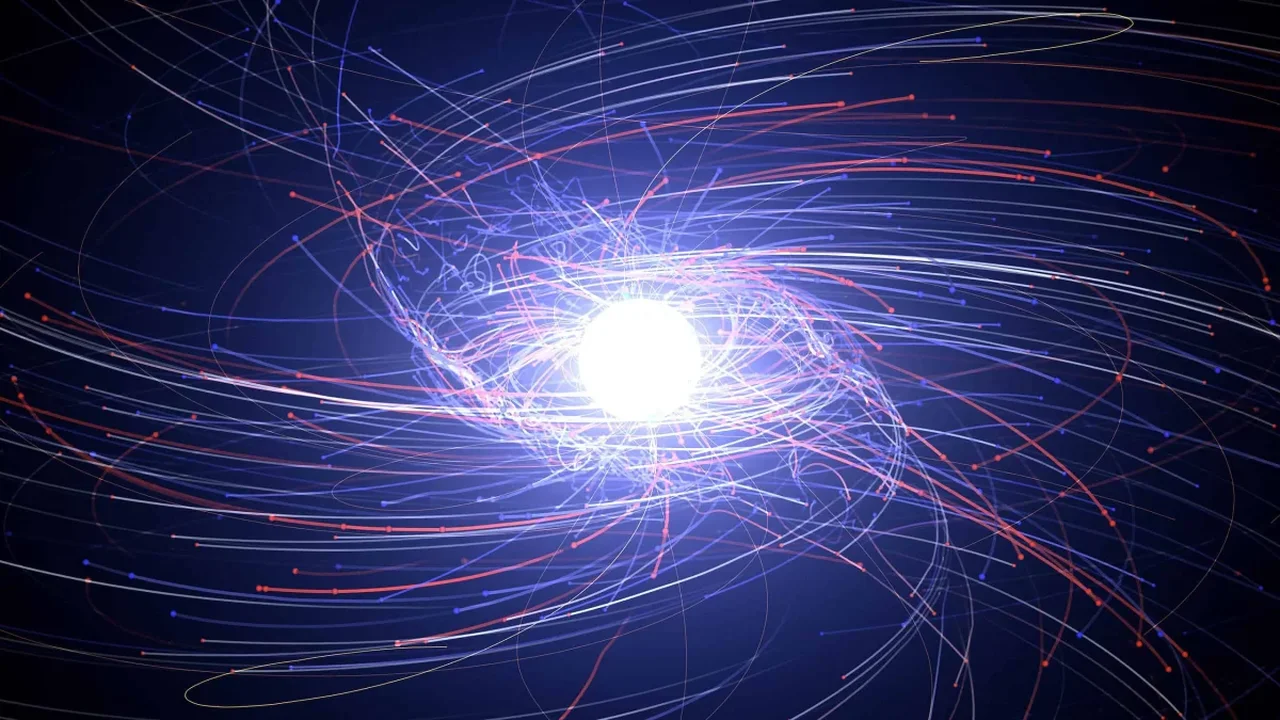
Why did matter survive the universe's earliest moments while antimatter largely disappeared? A theoretical study by Rishav Roshan of the University of Southampton and Sudipta Show of the Indian Institute of Technology Kanpur proposes that a little-considered heavy neutrino may have influenced the outcome.
In the aftermath of the Big Bang, matter and antimatter are thought to have formed in nearly equal quantities. When the two meet, they annihilate, leaving energy behind. A tiny surplus of matter--roughly one particle for every billion matter-antimatter pairs--ultimately provided the building blocks for stars, planets and life.
A brief shift in the early universe
The researchers examined a hypothetical particle called N3, one of three heavy neutrino relatives considered in the seesaw mechanism, a framework used to explain why ordinary neutrinos have such small masses. N3 may interact so weakly that it could have persisted in the young universe for a relatively long time.
As the cosmos expanded and cooled, N3 may have slowed and temporarily become a major component of the universe's energy. Its presence could have altered the expansion rate. Later, as the particle decayed, it would have released energy back into the surrounding universe.
The proposed effect is indirect. Other heavy neutrinos may have generated a small imbalance between matter and antimatter. But the changed expansion history could have shifted when particle interactions took place, affecting how much of that imbalance survived. In calculations published in Physical Review Letters, the researchers found that certain conditions could produce an excess consistent with what is observed today.
A promising idea, not a confirmed explanation
The study is theoretical: it does not establish that N3 existed or that this process occurred. The proposal also depends on the particle having been produced in the first place. Testing it will be difficult, though the researchers point to possible clues in neutrino mass measurements and primordial gravitational waves. Their model predicts an exceptionally small mass for the lightest neutrino, beyond current experiments' ability to measure directly.
Further measurements of neutrinos and the early universe could help determine whether this overlooked particle played a role in shaping the matter-filled cosmos we inhabit.